Best Foosball Tables for a Game Room
Foosball is the game room purchase people most often make twice. The first table is chosen on price and appearance, it arrives flat-packed at forty pounds, and within a year the rods have developed play, the men spin loose on their pins and the cabinet rocks whenever anyone plays a real shot.
The reason is simple. Foosball is a contact sport played through steel rods, and almost everything that goes wrong with a cheap table is a consequence of mass. Here is what separates a table that gets played for a decade from one that ends up listed for free on a local marketplace page.
Weight tells you almost everything
Foosball involves people slamming a hard ball with steel rods while leaning on the cabinet. A light table cannot absorb that. It walks across the floor, the joints work loose, and the playfield stops sitting flat, which changes how the ball rolls.
Rough tiers by weight, which track price closely:
- Under 100 pounds: thin particle board and hollow legs. Fine for young children, frustrating for adults inside a year.
- 150 to 250 pounds: the sweet spot for a home table. Thick cabinet panels, solid legs, and enough mass to stay put during a hard shot.
- 250 to 400 pounds: commercial and tournament builds, designed to be played on continuously by strangers.
If a listing does not publish a shipping weight, treat that as an answer. Weight is the cheapest quality signal available and good manufacturers advertise it.
The related check is cabinet thickness. Push down on a corner of the playfield and lean on the side rail. Anything that flexes under hand pressure will flex under play.
Rods, bearings and men
The rods are the part you actually touch, and they differ more than the cabinets do.
Telescoping versus through rods. Telescoping rods do not pass out the far side of the table, which means no steel pole in the ribs of whoever is standing there. They cost more and are the sensible choice for a home with children. Through rods are what most commercial tables use, they are simpler and stiffer, and they need roughly a foot of extra clearance on each side.
Hollow versus solid steel. Hollow rods are lighter and faster to move, which most players prefer once they get used to them. Solid rods feel more substantial and are harder to bend. Both are fine; rod diameter and bearing quality matter more.
Bearings. Cheap tables run the rods through nylon bushings pressed into the cabinet wall. Better tables use proper bearings, often octagonal, that can be replaced when they wear. This is the part that determines whether the table still feels crisp after five years.
Counterbalanced men. A counterbalanced player figure stays where you leave it instead of flopping forward under its own weight. On a table without them, the men hang into the playfield and block shots you did not intend to block. It is a small detail that changes the game noticeably.
Handles. Rubber or textured composite. Wooden handles look better in photographs and get slippery within an hour of play.
Sizes, prices and what each tier buys
- Tabletop, 20 to 40 inches: $40 to $120. A toy. Buy it as a toy and it is fine.
- Compact, 48 inches: $150 to $350. Genuine play, shortened field, usually light cabinets. A reasonable first table for a family.
- Full size, 55 to 56 inches: $400 to $1,200. Regulation playfield, real bearings, proper weight. Where most people should be looking.
- Commercial and tournament: $1,500 and up. Coin mechanisms, extremely heavy cabinets, standardised parts, built for bars and tournaments.
Regulation is about 56 inches long overall with a 4-foot playfield, and the surface sits around 36 inches from the floor. Tables that deviate from that are not wrong, but the game plays differently and you will notice when you next play on a standard one.
For room planning, allow about 4 feet of clear floor at each end so players can stand and pull rods back, plus side clearance if the table uses through rods. A full-size table in a room that only fits it diagonally is a table nobody plays.
Playfield, levelers and the surface underneath
Playfield material. A sealed laminate over a thick substrate is what you want. It should be smooth, uniformly coloured and free of texture. Cheap tables use a printed surface that wears through around the goals within a couple of years.
Flatness. Roll a ball slowly from one end. It should track more or less straight and not accelerate toward a corner. A playfield with a dip creates a dead zone where the ball parks and neither side can reach it.
Levelers. Every leg should adjust. Game room floors, especially basement slabs and older hardwood, are rarely flat, and an unlevel foosball table is unfair in a way players notice immediately but cannot always name.
Ball return and goal boxes. Check that a scored ball returns to the side rather than needing to be fished out, and that the return path does not rattle loudly enough to be annoying.
Scoring. Bead or slider scoring on the end rails is standard, it never breaks, and it is all you need. Electronic scoring on a foosball table is a feature waiting to fail.
Keeping one playing well
Foosball maintenance is short, and most owners skip all of it.
Silicone the rods. A few drops of silicone lubricant on each rod, wiped down, every month or two. This is the single thing that keeps a table feeling fast. Avoid oil-based lubricants, which attract grit and gum up bearings.
Tighten the men. Player figures are held on by pins or set screws that work loose. A quick pass with a hex key twice a year prevents a man from spinning free mid-game.
Clean the playfield. A dry or barely damp cloth. Never polish or wax it, which makes the ball skid instead of roll and ruins ball control.
Replace the balls. Foosball balls are consumable. Textured cork or composite balls grip the men and slow down predictably; smooth plastic balls skid. They cost a few dollars and are the cheapest improvement available to a mediocre table.
Keep drinks off it. A sticky playfield ruins the roll, and cabinets in damp basements swell at the seams.
Where the money should go, in order: cabinet weight, bearings, counterbalanced men, telescoping rods, then everything else. A plain heavy table with good bearings beats a light table with lights, cup holders and a scoreboard every time, and it will still be there when the light table is not.
Our picks
Links open the current selection and price on Amazon so you can compare real reviews before buying.
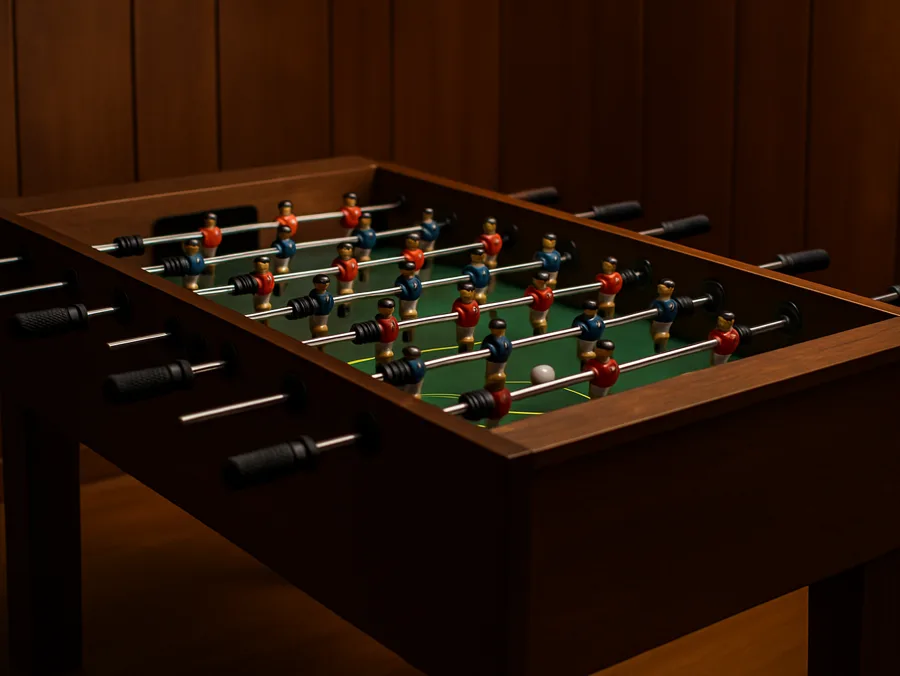
Full size tournament foosball table
A table that survives adultsHeavy cabinet, chrome rods, counterbalanced men and levelers on every leg. The weight class where a table stays tight for years instead of months.
Check price on Amazon
48-inch home foosball table
Families and smaller roomsA shorter playfield and a lighter build, at a price that makes sense if the table is mostly for kids. Prioritize bearings and levelers over graphics.
Check price on AmazonReplacement foosball balls
Fixing ball control cheaplyTextured cork or composite balls grip the men and stop predictably where smooth plastic skids. The cheapest upgrade any table can get.
Check price on AmazonSilicone rod lubricant
Keeping rods fastA few drops per rod every month or two is what keeps a table feeling quick. Silicone only, never an oil-based lubricant that collects grit.
Check price on AmazonFrequently asked questions
How much should I spend on a foosball table?
Between $400 and $1,200 buys a full-size table heavy enough to stay tight, with real bearings and counterbalanced men. Under about $300 you are buying a light cabinet that will loosen with use, which is fine for young children and frustrating for adults.
Are telescoping rods better than through rods?
For a home, usually yes. Telescoping rods do not protrude out the far side, so nobody gets jabbed and the table needs less side clearance. Through rods are stiffer and simpler, which is why commercial tables use them, but they need about a foot of extra space on each side.
What size is a regulation foosball table?
About 56 inches long overall with a playfield of 4 feet by 2 feet 6 inches, standing roughly 36 inches high. Allow about 4 feet of clear floor at each end for players, plus side clearance if the rods pass through the cabinet.
Why does my foosball table feel slow?
Almost always dry rods. Wipe them down and apply a few drops of silicone lubricant to each one. After that, check for loose men, a sticky playfield and worn balls, which are the next three causes in order of likelihood.
Related guides
LeaguePool is reader-supported. When you buy through links on this site we may earn an affiliate commission at no extra cost to you. As an Amazon Associate we earn from qualifying purchases.