How to Store a Pool Cue (Avoid Warping)
Store a pool cue upright, in a rack or in a case stood on end, in a room that stays around 70 degrees with humidity near 40 to 50 percent. That's McDermott's published target, and Predator's is close (45 to 50 percent). Never lean it against a wall, and never leave it in a car.
Most warped shafts come from one of those three mistakes. The rest of this page is the detail: which position, which room, what to do for a long break, and how carbon shafts change the rules.
The storage rules on one screen
| Do | Don't |
|---|---|
| Hang it vertical in a rack, tip up | Lean it in a corner or against the table |
| Stand the case upright | Lay a soft case on a shelf under other things |
| Keep the room near 70 F and 40 to 50 percent humidity | Store it in a damp basement, attic or garage |
| Use an interior wall | Mount a rack on an outside wall |
| Screw on joint protectors when it's broken down | Leave the joint and shaft end bare |
| Bring it inside after league night | Leave it in the trunk overnight, summer or winter |
Vertical, flat or in the case
Vertical is the position cue makers recommend. A cue hanging straight down from its own weight has nothing pushing it sideways. Predator's care notes say to store cues upright and warn that leaning a wood cue against a wall, or laying it across a table, can warp the shaft over time. A rack does this for an assembled cue: see our rack roundup for wall and floor options.
For a broken-down cue, stand the case on end. McDermott's advice for long storage is a case stored vertecally, and the old rec.sport.billiard FAQ that Dr. Dave reprints says the same: stand a case upright rather than laying it down, and hang a soft case from a hook in a closet.
Flat is the fallback, not the goal. A hard case lying flat on a shelf supports the cue along its whole length, which is fine for a short spell. The danger is a cue resting on two points (two pegs, the rails of a table, the edge of a box) with nothing in between. It sags there, slowly.
Humidity and temperature: the numbers
| Source | Temperature | Humidity |
|---|---|---|
| McDermott cue care | About 70 F, consistent | 40 to 50 percent |
| Predator care FAQ | Stable and consistent | 45 to 50 percent |
| Our pool table humidity guide (room) | Reasonably steady | 40 to 50 percent, 60 at most |
Stability counts as much as the number..... Wood takes on and gives up moisture, and McDermott notes that temperature and humidity extremes cause expansion that can warp a cue and damage its finish. Swings also stress the joint and ferrule, which are made of different materials that move at different rates (Dr. Dave's FAQ makes this point).
A cheap digital hygrometter next to the rack tells you where the room really sits. If it reads over 60 percent in summer... a dehumidifier fixes the room for the table and the cues at once; under 40 percent in a heated winter house, a humidifier. Sizing both is covered in the table humidity guide.
The car is the worst place for a cue
Leaving a cue in the trunk in summer heat raises the risk of warpage, per Predator's FAQ, and Dr. Dave's FAQ adds the cold side: a cue left in a freezing car is at risk too. A trunk swings from hot to cold every day and night, which is exactly the instability every cue maker tells you to avoid.
Two habits help. Carry the cue in with you after league, every time, even if you're tired. And when a cue has been in a cold car, leave it zipped in its case for a while indoors so it warms gradually, rather than opening it next to a heater. A case slows a temperature change; it doesn't stop one.
Where in the house
- An interior wall in a lived-in room is the best spot. McDermott specifically says to avoid wall racks installed on an outside wall.
- Not near heating vents, radiators, wood stoves or a sunny window. Heat on one side dries one side of the shaft faster than the other.
- Not in a damp basement, unless you run a dehumidifier there and the hygrometer agrees. Predator says to keep cues away from damp basements, heaters and sunny windows.
- A bedroom or hall closet on an inside wall works well for a cased cue stood upright.
- Garages, attics and sheds are out. They follow the outdoor weather.
Storing a cue for months (off-season or between leagues)
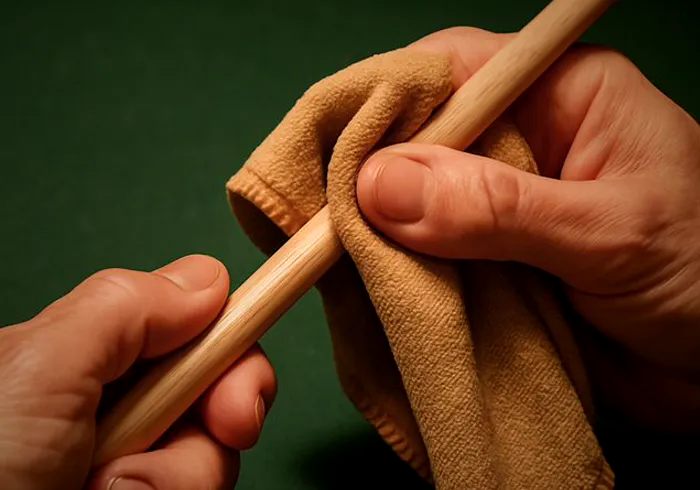
- Clean the shaft first. McDermott warns against shaft products with waxes or oils such as silicone and lanolin, which can soften the wood. For what to use, see how to clean a cue.
- Break it down and fit joint protectors on both the butt and the shaft. McDermott says they protect the pin and threads and seal the unfinished end of the shaft from moisture. Sizing is in our joint protector roundup.
- Stand the case upright in a closet on an interior wall. For long storage McDermott suggests leaving the case open so air can move.
- Take it out once a month or so, sight down the shaft, and put it back. A problem caught early is easier to deal with.
- Leather cases want the same dry, cool, out-of-the-sun spot. Predator's leather care guide recommends a breathable dust bag, not plastic, for long storage.
Carbon fiber shafts change the risk, not the habits
Carbon shafts resist the moisture movement that bends maple. Predator's warranty reflects it: warpage is not covered on wood shafts, but it is covered on its REVO and Venom carbon shafts. That doesn't make carbon storage-proof. Predator also notes carbon can chip or crack from impacts, so a carbon shaft still belongs in a rack or a hard case, and the wood butt it screws into still reacts to heat and humidity.
What your warranty says about storage
How you store a cue can decide a warranty claim. McDermott's lifetime warranty covers warpage for the original owner (on cues made after its 2004 warpage warranty began), but it excludes damage caused by exposure to extreme temperature or humidity. Predator doesn't cover warpage on wood shafts at all and excludes damage from extreme temperature or humidity on its accessories.
Translation: a cue that warps in a hot trunk is on you. Store it the way the maker says and keep your receipt.
If the cue already looks bent
Check it properly before you worry. Sight down the cue from the butt end while rotating it; rolling it on a table mostly shows up joint problems, not a bent shaft, per Dr. Dave's FAQ. Our guide to warped cues walks through the tests, what a normal amount of movement looks like, and when a shaft is worth replacing. Better storage won't straighten a badly bent shaft, but it stops a small bend from growing.
Looking for a billiards store instead?
If you searched for a pool cue store to buy a cue, a local billiards store is worth the trip for one thing online can't do: you can roll and sight a cue before paying. Our checklist for buying a used cue lists what to look for, and best pool cues on Amazon covers buying online. For tables, start with our table buying guide.
Sources
- McDermott: cue maintenance tips (temperature, humidity, racks, cases, joint protectors)
- McDermott: lifetime warranty terms
- Predator: warranty and care FAQ (humidity, trunks, leaning, carbon shafts)
- Predator: cue holder page (upright storage, heaters, windows, basements)
- Predator: leather case care
- Dr. Dave Pool Info: cue care FAQ
Our picks
Links open the current selection and price on Amazon so you can compare real reviews before buying.

Wall-mounted cue rack
Safe vertical storageHolds cues straight up and down so they can't lean or sag. Mount it on an interior wall, away from vents and windows.
Amazon price: $32.21 as of 4:35 AM EST. Price and availability can change; Amazon’s price at purchase applies.
Check price on Amazon
GACCO Freestanding Wooden Cue Rack, Holds 8 Cues
Rooms without wall spaceKeeps eight cues vertical without drilling: two levels of 18 mm solid wood, 24 inches tall, with rubber feet so it stays put on the floor. Move it to an inside wall if the only open wall in the room is an exterior one.
Amazon price: $37.99 as of 4:35 AM EST. Price and availability can change; Amazon’s price at purchase applies.
Check price on Amazon
TempPro TP50 Digital Hygrometer
Knowing your room's humidityReads humidity to within 2 to 3 percent and temperature to within 1 degree, refreshes every 10 seconds, and records highs and lows, so you can see whether the cue room swings overnight. A stand and a magnetic back let it sit on a shelf by the rack. Battery included.
Check price on Amazon
McDermott Joint Protector Set (3/8 joint)
McDermott owners storing a cue broken downA two-piece set in heavy-duty plastic that keeps dirt and damage off the pin and threads. It fits McDermott cues with a 3/8 joint only; other joints need their own size.
Amazon price: $24.00 as of 4:58 AM EST. Price and availability can change; Amazon’s price at purchase applies.
Check price on Amazon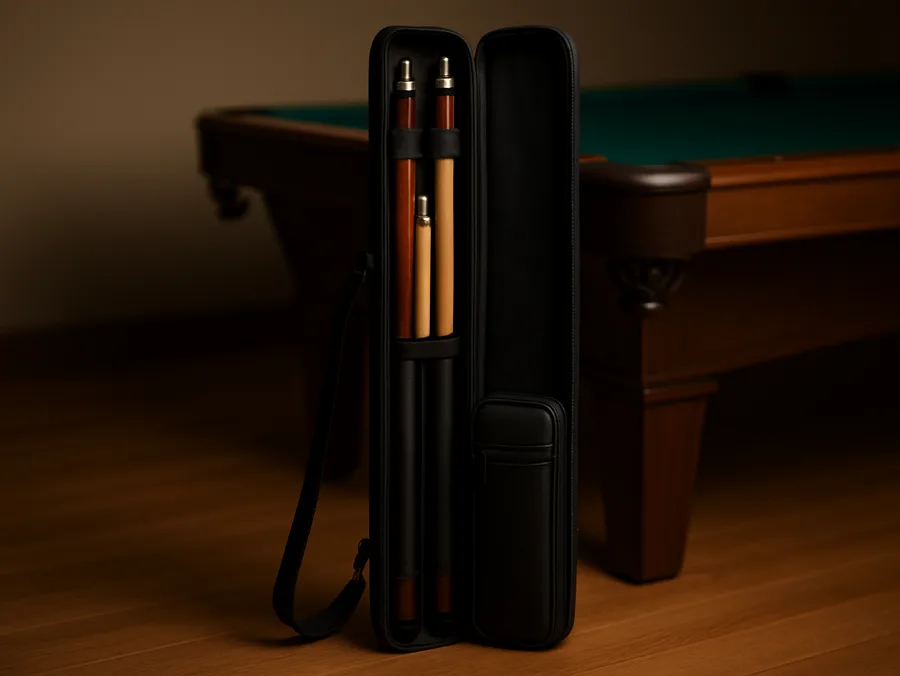
Hard cue case for storage
Broken-down long-term storageA padded hard case, stood on end in a closet, protects a disassembled cue from knocks and dust. For long storage, leave it unzipped so air can move.
Check price on AmazonFrequently asked questions
Is it better to store a pool cue vertically or flat?
Vertically. Cue makers recommend upright storage in a rack, or a case stood on end. Flat is fine only if the whole length is supported, as in a hard case. Never lean the cue at an angle.
What humidity should I store a pool cue in?
McDermott recommends about 40 to 50 percent at around 70 degrees, and Predator says 45 to 50 percent. A steady room matters as much as the number.
Will leaving my cue in the car warp it?
It can. A summer trunk raises the risk of warpage, Predator warns, and cold cars are a problem too. Bring the cue inside every time.
Should I store my cue in its case?
Yes, especially a two-piece cue that's broken down. Stand the case upright with joint protectors fitted. For extended storage, McDermott suggests leaving the case open for air.
Can I store cues in the basement?
Only if it's dry and stays dry. A hygrometer reading above about 60 percent means run a dehumidifier or move the cues upstairs.
Do carbon fiber shafts need special storage?
Less worry about warping, since Predator even covers warpage on its carbon shafts, but they can still chip or crack from knocks, so use a rack or a hard case.
Can a warped cue be fixed?
A slight bend is often still playable, but a badly warped shaft is usually replaced. Our warped cue guide has the tests and options.
Related guides
LeaguePool is reader-supported. When you buy through links on this site we may earn an affiliate commission at no extra cost to you. As an Amazon Associate we earn from qualifying purchases.