Best Dart Boards: Bristle, Electronic and Board Types
A bristle dartboard is a disc of sisal fibers packed on end so tightly that a steel point slips between them and the fibers close back up when the dart comes out. That self-healing trick is why a good bristle board lasts years, and it's why the World Darts Federation only approves sisal bristle boards for its tournaments.
For most adults setting up a game room, that's the board to buy: a staple-free sisal board, hung with the bull 5 feet 8 inches off the floor and a throw line 7 feet 9.25 inches back. Electronic soft tip boards have a real place too, mostly in homes with young kids or players who want the machine to keep score. Below are the board types, what separates a good bristle board from a cheap one, cabinets and surrounds, the exact setup numbers for both steel and soft tip, and how to make a board last.
Types of dart boards at a glance
There are four kinds of dartboard on sale, and only two of them are worth a game room.
| Type | Made of | Darts | Good for | Watch out for |
|---|---|---|---|---|
| Bristle (sisal) | Compressed sisal fiber, wire spider on the face | Steel tip | Real darts, league practice, adults | Steel points and drywall; needs rotating |
| Paper or coiled paper | Tightly wound paper | Steel tip | Cheap first board for casual home play | Not sisal, so not what leagues or the WDF use |
| Electronic | Plastic segments with small holes, sensors behind | Soft tip (plastic points) | Families, automatic scoring, dozens of built-in games | Bounce-outs, worn segments, needs power |
| Magnetic | Printed fabric over magnetic backing | Magnetic darts | Young children, hanging anywhere | A toy; won't build a real throw |
The rest of this page is mostly about bristle boards, because that's what most of our search traffic asks about and what most adults end up owning. If you're torn between bristle and electronic, the next section settles it.
Bristle vs electronic: which to buy
Pick bristle if the people throwing are adults or teenagers who want to play the game the way it's played in leagues and on TV. The board is quiet, it looks right on a wall next to a pool table, it never needs batteries, and a steel tip dart sticks where it lands. You keep score yourself, on a chalk or dry-erase board.
Pick electronic if young kids will be throwing, if nobody wants to subtract from 501 in their head, or if you want the board to run cricket, handicaps and party games for you. Plastic points are far kinder to walls and to people. The trade-offs are real, though: soft tips bounce out more often, the plastic segments eventually need replacing, the board needs power, and you're tied to light darts. The National Dart Association, which runs soft tip leagues in the US, caps a complete soft tip dart at 20 grams.
Two practical notes. Never throw steel tip darts at an electronic board; they wreck the plastic segments. And on electronic boards, look at target size before game count. Many full-size models list a 15.5 inch target, while compact ones run about 13 to 13.5 inches, which is a noticeably smaller board to aim at.
What is a bristle dartboard, and what makes a good one
Sisal comes from an agave plant, and the better boards use Kenyan sisal (Winmau says so of its own boards, and Shot Darts says the same of its range). The fibers are cut, bundled point-out and compressed into a disc, then the face is sanded and printed with the segment colors. A dart parts the fibers instead of punching a hole, which is the whole reason the board heals.
Bristle boards look alike in photos. These are the differences that change how the board plays:
- The wire, called the spider. This matters most. Old-style boards use thick round wire held down with staples, and a dart that clips a staple bounces out. Better boards drop the staples and use thin triangular or blade-shaped wire that steers a dart into a bed instead of knocking it back. The WDF allows wire from 1.27 to 1.85 mm thick, so the thin end of that range is what you're paying for.
- A staple-free bull. The inner and outer bull take more darts than anything except the treble 20, so a bladed or staple-free bull cuts bounce-outs where they happen most.
- A removable number ring, so you can turn the board and spread wear (more on that below). A fixed ring means the treble 20 wears out and the board is finished.
- A center mounting bracket that lets the board sit flat and turn without coming off the wall. Winmau's Rota-Lock bracket does this, and so does the center screw plus three spring clips that Harrows describes in its setup guide.
- A firm, even face. A cheap board feels spongy, holds darts loosely and sheds fiber from the 20 within months.
A regulation board is 451 mm across, about 17.75 inches. The WDF spec also fixes the trebles and doubles at 8 mm inside the wire, so a board sold as regulation size gives you the same targets you'd see in a league.
Cabinet, surround or backboard
Steel tips miss. Even good players put darts outside the double ring, and drywall doesn't heal like sisal. Something has to sit around the board before the first game, and there are three ways to do it.
| Option | What it is | Pick it when |
|---|---|---|
| Cabinet | Wood box with doors that close over the board; scoreboards inside the doors | The board shares a living space or bar and you want it hidden between games |
| Surround | Foam or rubber ring that fits around the board, no fixings | A dedicated darts spot; it catches more misses close to the board than a cabinet does |
| Backboard | Plywood, cork or a panel wider than the board, fixed to the wall | A garage or basement wall where looks don't matter and you want the widest catch area |
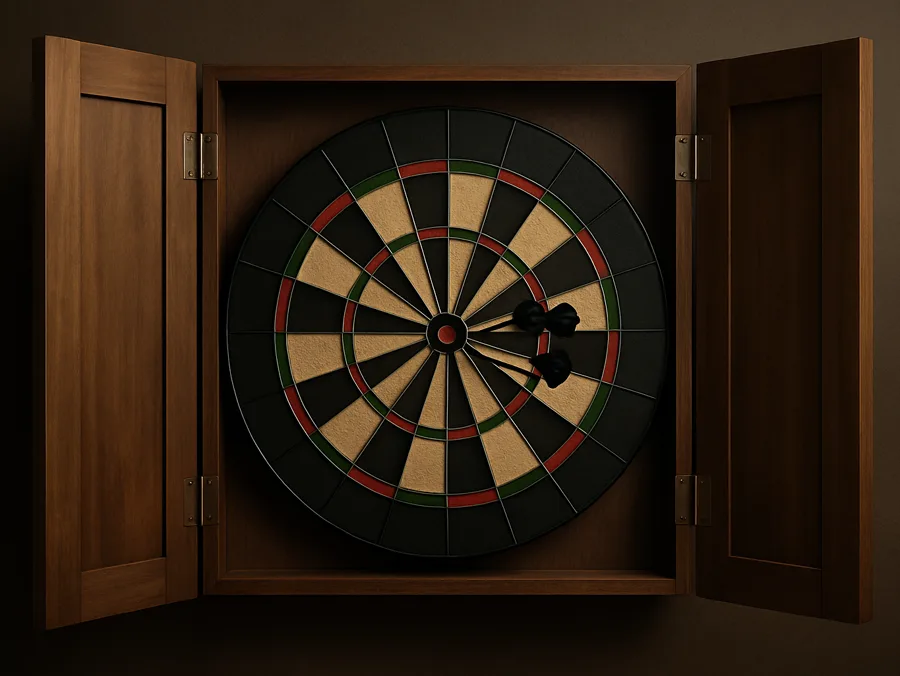
Searchers ask a lot about the best bristle dartboard with a cabinet. Our pick is the Viper Stadium set below because the listing covers the parts a beginner otherwise buys one at a time: a 17.75 inch Shot King sisal board with a rotating number ring, two dry-erase scoreboards, a flip-up Shadow Buster light, a throw line marker and six steel tip darts. A cabinet protects the wall right next to the board, but darts that miss the cabinet itself still hit the wall, so the setup guides from Harrows suggest keeping about 60 cm (2 feet) of clear wall on each side of the board.
Winmau notes that the center screw on its boards is built to hold the board and a standard surround. Heavy add-ons hung from the board, like some lights, can overload it and pull the board off the wall.
Regulation dartboard height and throw distance
These are the numbers the World Darts Federation sets for steel tip, and the ones the National Dart Association uses for soft tip. Practicing at the wrong distance builds a throw you'll have to unlearn, so measure twice.
| Measurement | Steel tip (WDF) | Soft tip (NDA) |
|---|---|---|
| Floor to center of bull | 1.73 m (5 ft 8 in) | 5 ft 8 in (68 in) |
| Board face to throw line, along the floor | 2.37 m (7 ft 9.25 in) | 96 in (8 ft) |
| Diagonal, bull to throw line at the floor | 2.93 m (about 9 ft 7 3/8 in) | about 9 ft 9 5/8 in (our math from the two numbers above) |
| Board diameter | 451 mm (about 17.75 in) | Varies by model; many full-size boards list a 15.5 in target |
| Maximum dart weight | 50 g | 20 g |
Three mistakes show up again and again in setup guides:
- Measuring the throw distance from the wall. Measure from the face of the board, which sits an inch or more off the wall once it's on a bracket or in a cabinet.
- Measuring height to the top of the board. It's to the center of the bull. Harrows points out that the top of a board sits about 17 cm (roughly 6.75 inches) above that.
- Skipping the diagonal. If both the height and the throw line are right, the diagonal will be too. If it isn't, one of the other two is off.
US guides often round the steel tip diagonal to 9 ft 7.5 in. The WDF figure of 2.93 m works out a hair shorter; either will tell you if something is badly wrong. Harrows gives 137 cm (4 ft 6 in) to the bull for wheelchair players, with the same throw distance.
For space, Harrows suggests a lane about 5 feet wide and 11 feet long. Keep that lane out of the walkway, and never let it cross the shooting area of a pool table; someone backing up for a long shot shouldn't be in the line of fire. Our pool table room ideas guide covers clearance zones for the table side of the room.
Lighting and the floor
Overhead room light puts your own shadow on the board. The WDF requires at least 1,600 lumens on every tournament board, screened so the light doesn't shine into the thrower's eyes. At home, a ring or arc light that clips to the board or surround is the usual fix, and bright white LEDs show the segment colors most accurately. A pool table light won't help; it hangs low over the table and points down. If you're lighting the table too, see pool table lights.
A dart that bounces out lands point first. Tile and hardwood blunt points and can crack barrels, so a dart mat in front of the board saves both the floor and the darts. Better mats, like the Target one below, print the steel tip and soft tip lines at the right distances, which also saves you the measuring. The WDF's tournament oche is a raised bar 38 mm high and 610 mm long; at home a strip of tape or a stick-on line does the same job.
Darts to start with
The darts in a cabinet set are fine for learning. The first upgrade most players notice is tungsten. Tungsten is much denser than brass, so a dart of the same weight has a slimmer barrel, and three darts fit in the treble 20 without knocking each other out.
Weight is personal. Steel tip sets on sale mostly run from about 20 to 26 grams (the Red Dragon Javelin line spans exactly that range), well under the WDF's 50 gram limit. Start in the middle and adjust: if your darts are dropping low, try heavier; if they feel like they need a shove, try lighter. Soft tip players are capped at 20 grams for NDA league play, so check before buying a heavy soft tip set.
Buy spare flights and shafts with any set. They break all the time, and a bent shaft changes the flight more than people expect.
Making a bristle board last
Rotate it. Everyone aims at the 20, so that bed and the treble below it wear first. Unclip the number ring, turn the board one segment (Shot Darts gives the example of the old 20 moving to where the 12 was), and put the ring back with 20 at the top. Shot Darts suggests doing this about every two weeks on a board used a few times a week, turning the same direction each time.
Rotation has one limit. Winmau points out that it does nothing for the bull and outer bull, so a household that plays a lot of cricket will wear out the center first. When the bull goes soft and darts start falling out of it, the board is done.
Keep it dry. Sisal soaks up moisture and swells. Winmau says not to soak or spray a bristle board at all, and to keep it somewhere cool and dry, which rules out a damp basement wall or a covered patio. If the board shares a room with a pool table, the 40 to 50 percent humidity target in our pool table humidity guide suits the board too.
Look after the points. Blunt points push fibers together instead of parting them, and hooked points pull fibers out as you pull the dart. Keep points smooth and sharp, and twist the dart slightly as you remove it, as Winmau recommends.
If you only buy one thing
Spend on the board first. A good staple-free sisal board with cheap darts is a fine night of darts; expensive tungsten thrown at a stapled paper board just collects bounce-outs. Then protect the wall, then add a light. If you'd rather do it in one box, a cabinet set covers all three at once.
Planning a full game room? A dartboard is the cheapest game you can add next to a pool table. See multi-game tables, air hockey tables, foosball tables and shuffleboard tables for the rest of the room.
Sources
- World Darts Federation: Playing and Tournament Rules (dartboard spec, lighting, board setup and oche)
- National Dart Association: NDA rules (soft tip throw line, board height, dart weight)
- Winmau: Blade 6 setup and care
- Harrows Darts: how to set up a dartboard (wheelchair height, lane size)
- Shot Darts: how to look after your dartboard
Our picks
Links open the current selection and price on Amazon so you can compare real reviews before buying.
Viper Stadium Cabinet and Shot King Bristle Dartboard
Best bristle dartboard with cabinetEverything a first setup needs in one box: a 17.75 inch Shot King sisal board with a staple-free bull and rotating number ring, a walnut-finish cabinet with two dry-erase scoreboards, a flip-up Shadow Buster light, a stick-on throw line and six steel tip darts. The light is the part most people forget to buy and then wish they had.
Check price on Amazon
Winmau Blade 6 Dartboard
Best bristle board on its ownSisal with ultra-thin wiring to cut bounce-outs, a laser-cut number ring you can turn as the 20 wears, and the Rota-Lock bracket with a built-in level so the board hangs straight and stays put. Pair it with a surround or backboard to protect the wall.
Check price on Amazon
Red Dragon Javelin Tungsten Darts
First tungsten upgrade85 percent tungsten barrels, offered from 20 to 26 grams, so the same weight is a slimmer dart and three of them fit the treble without crowding. Comes with shafts, flights and a case; 23 or 24 grams is a sensible place to start if you have no preference yet.
Check price on Amazon
Target Darts World Champions Dart Mat
Floors and the throw lineA rubber-backed carpet mat with both steel tip and soft tip throw lines marked at tournament distances. It saves hardwood and tile from dropped points, saves your points from the floor, and rolls up when the room goes back to being a room.
Check price on AmazonFrequently asked questions
What is a bristle dartboard?
A dartboard made of sisal fibers packed tightly on end and compressed into a disc. A steel tip dart slides between the fibers instead of punching a hole, and the fibers close back up when you pull it out. Bristle is the only type the World Darts Federation approves for its tournaments.
What are the different types of dart boards?
Bristle (sisal) boards for steel tip darts, paper or coiled paper boards for steel tip at a lower price, electronic boards with plastic segments for soft tip darts and automatic scoring, and magnetic boards for young children. Adults who want real darts buy bristle; families with small kids often start electronic.
How high should a dartboard be hung?
The center of the bull goes 5 feet 8 inches (1.73 m) from the floor for both steel tip and soft tip. Steel tip players throw from 7 feet 9.25 inches (2.37 m) measured along the floor from the face of the board; soft tip leagues use 8 feet. For wheelchair players, Harrows gives 4 feet 6 inches (137 cm) to the bull with the same throw distance.
Is an electronic or bristle dartboard better?
Bristle is better for adults who want to play steel tip darts properly: quieter, longer lasting, and it's the game leagues play. Electronic is better for homes with young kids or players who want automatic scoring and built-in games. They use different darts, so decide before you buy darts.
How often should I rotate a dartboard?
About every two weeks if the board gets played a few times a week. Unclip the number ring, turn the board one segment the same direction each time, and refit the ring with 20 at the top. Rotating doesn't help the bull, which wears out first in homes that play a lot of cricket.
Can I use steel tip darts on an electronic dartboard?
No. Steel points damage the plastic segments and the sensors behind them. Electronic boards take soft tip darts only, and NDA league rules cap a complete soft tip dart at 20 grams.
Should I wet or soak my dartboard?
No. Sisal swells and breaks down with moisture. Winmau says never to soak or spray a bristle board and to keep it in a cool, dry place.
Related guides
LeaguePool is reader-supported. When you buy through links on this site we may earn an affiliate commission at no extra cost to you. As an Amazon Associate we earn from qualifying purchases.