Best Poker Tables and Poker Table Tops for Home
For most home games, the best poker table is a folding poker table top on the table you already own. The Trademark wood top is 78.5 by 36 inches, seats 8, and folds to 20 by 36 inches with a carry bag. If you have no table to put it on, the Barrington 48 inch folding table stands 30 inches tall, has a padded armrest and eight cup holders, and folds to 5.5 inches deep. Furniture-grade tables from makers like BBO and Brunswick start around $1,200 and run past $4,000.
Below: the three formats compared, the best poker table tops, putting a top on a pool table, seating by shape, speed cloth versus felt, and the chips and cards that matter as much as the table.
Poker table top, folding table or full table?
| Poker table top | Folding poker table | Furniture poker table | |
|---|---|---|---|
| What it is | A shaped board with a playing surface that sits on another table | A playing top with its own folding legs | A solid table, often with a dining top |
| Example | Trademark wood top, 78.5 x 36 in, 8 seats | Barrington 48 in octagon, 30 in tall, 8 seats | BBO and Brunswick tables |
| Storage | Folds to 20 x 36 in, carry bag | Folds to 5.5 in deep, 47.3 lb | Stays put |
| Padded rail | Not on the Trademark listing | 1 in faux leather armrest | Yes, usually the main comfort feature |
| Pick it if | You have a sturdy dining table and play monthly | You have no base table, or play in a garage or basement | The game is weekly and the room is permanent |
There's a fourth option, the roll-out layout: a printed cloth mat for an existing table. It's the cheapest way to get a betting line and the least like a real table, since there's no rail and nothing to stop chips sliding off the edge.
The folding top wins for most people because a game that's easy to set up actually happens. Put the money you save into chips and cards.
The best folding poker table tops
The Trademark Solid Wood Folding Poker Table Top is the one we'd start with. It's a 1/2 inch wood board under green felt, 78.5 by 36 inches, marked with a yellow betting border for Texas Hold'em. Each of the 8 seats has a removable cup holder, four chip trays clip in on spring-loaded pins, and the whole thing folds to 20 by 36 inches and zips into a nylon bag with a two-way zipper.
Two things the listing doesn't promise: a padded rail and speed cloth. The surface is felt, and no padding is mentioned. For a monthly game that's an easy trade for the price and the storage. If your sessions run four hours, step up to a table with an armrest.
Fit is simple once you measure. A top should be longer and wider than the table under it, but not so much bigger that it tips when someone leans on the edge. On a 60 by 36 inch dining table, the Trademark top overhangs about 9 inches at each end and sits flush on the sides. On a small square card table, most of it would hang in the air.
Shopping for the best poker table top comes down to the table underneath: rectangle and oval tops suit a long dining table, and round and octagon tops suit a square one. BBO puts round tables at 6 to 8 players.
Pool table poker table top
A pool table makes a good base for poker because it's big and solid, and it's already in the game room. Don't set a poker top straight on the cloth or rails, though. A 7 foot table's playfield is about 76 by 38 inches between the cushions, so a 36 inch wide top like the Trademark can drop inside the rails and rest on the cloth, where chip trays, drinks and elbows press on it.
Lay a hard cover or a dining top over the pool table first, then put the poker top on that. Rigid tri-fold covers are in our hard pool table covers guide, and full dining tops are in the conversion tops guide. If you're shopping for a small game table anyway, octagon bumper pool tables often come with a flip-over poker top, and their eight sides seat players evenly.
The best foldable poker table
The Barrington 48 inch octagon folding table is a complete poker table that disappears behind a door. The top is MDF with a velvet playing surface, wrapped by a 1 inch (20 mm) black faux leather armrest. Each of the 8 stations has a metal cup holder 1.22 inches deep. The legs are 30 mm square powder-coated steel with 0.71 inch adjustable levelers, and when they fold the table is 5.5 inches deep. It weighs 47.3 pounds and stands 30 inches tall.
What to check on any folding table:
- Leg lock and levelers. A folding table that wobbles knocks over stacks. Barrington lists 0.71 inch levelers; look for them on any listing.
- Cup holder depth. The Barrington's are 1.22 inches deep, fine for a short glass and risky for a tall can. BBO says 4 inch cup holders fit large glasses, bottles and most wine glasses.
- Seam and surface. Velvet and felt look fine and slow the cards a little; speed cloth is the upgrade (see below).
BBO also makes folding ovals and rounds (its Smart Fold line) if you want a folding table with a furniture-grade build.
Poker table size and seating
| Shape and size | Comfortable seats | Notes |
|---|---|---|
| 48 in octagon | 8 | Barrington's folding table; even seating on eight sides |
| Round | 6 to 8 | BBO: takes less room, easiest when the deal rotates; hard to find one that seats 10 |
| Rectangle top, 78.5 x 36 in | 8 | Trademark top on a dining table |
| Oval, 4 x 8 ft | 8 to 9 | BBO's size for a full Hold'em game; the casino shape |
BestReviews puts the range of poker tables at 4 to 11 players, with 8 the most common setup. That matches what most home games need. Ovals are what casinos use, because a dealer in the middle reaches every seat. In a home game where the deal moves around the table, a round or octagon is easier: nobody at the far end of an 8 foot oval has to pitch cards the length of the table.
Leave room for chairs to slide back. A table that seats 8 on paper seats 6 in a room where the chairs hit the wall.
Speed cloth vs felt
Most tables ship with standard felt, velveteen or micro suede. BBO, which makes tables, is candid about it: cards don't slide as well, especially for a dealer at the end of a long table, and a spill soaks in and stains. Speed cloth is a polyester weave (BestReviews says often polyester and olefin). Cards glide across it, and it resists liquid long enough to grab a towel.
Our take: speed cloth is the one surface upgrade worth paying for on an oval, and nice to have on a round. If you keep felt, BBO suggests treating it with a water-repellent spray. For a stain, dab with cool water on a soft cloth; for a stubborn one, BestReviews suggests 1 part white vinegar to 2 parts water.
Rails and cup holders: the extras that matter
A padded armrest is the feature players feel most over a long night, and BBO calls it one of the most important for comfort. Press it before you buy if you can. On a listing, look for the thickness: Barrington states 1 inch.
Get cup holders, and get them deep. A drink on the playing surface is the most common way a nice table gets ruined.
A racetrack, the wood strip between the rail and the felt, is taste. BBO notes most casino tables are full felt with no racetrack.
Skip a dealer cutout unless you'll have a dedicated dealer. Rotating dealers don't use it. LED rail lights, USB chargers and built-in shufflers are options on high-end tables; none of them makes the game better, and they add things to break.
What a home game needs besides the table
The table is often the cheaper half of a good game.
Chips. The Poker Store's chip guide says a 500-chip set covers a 10-player tournament. The DA VINCI 500-piece set uses 11.5 gram clay composite chips, which stack without slipping, and comes in an ABS case with two decks of plastic cards, cut cards and dealer and blind buttons.
Cards. Plastic cards are washable and last far longer than paper, which bends and gets sticky. The DA VINCI Ruote set is two poker-size decks (2.5 by 3.5 inches) of 100 percent plastic, made in Italy.
Light. A low pendant over the middle of the table lights the cards without glare in anyone's eyes; it's the same rule as lighting a pool table.
What to buy
- Monthly game, dining table available: a folding top like the Trademark, plus a 500-chip clay set and plastic cards.
- No suitable base table, or the game lives in a garage: a folding table with a padded rail, like the Barrington 48 inch.
- Weekly game in its own room: a furniture table with speed cloth and a padded rail. BBO's tables were listed from $1,199 on sale to $4,299 on October 15, 2026, and Brunswick's poker tables sat in its $4,000 to $7,999 price bands the same day. A dining top makes it earn its floor space.
Whatever you buy, rail padding and a stable base matter more than lights and logos.
Sources
- BBO Poker Tables: choosing a table shape
- BBO Poker Tables: choosing a playing surface
- BBO Poker Tables: Texas Hold'em tables (size, cup holders, armrests)
- Brunswick Billiards: poker tables
- The Poker Store: how many chips do I need
- Manufacturer specs from the Amazon listings for the Trademark folding top, Barrington 48 inch folding table, DA VINCI chip set and DA VINCI Ruote cards
Our picks
Links open the current selection and price on Amazon so you can compare real reviews before buying.
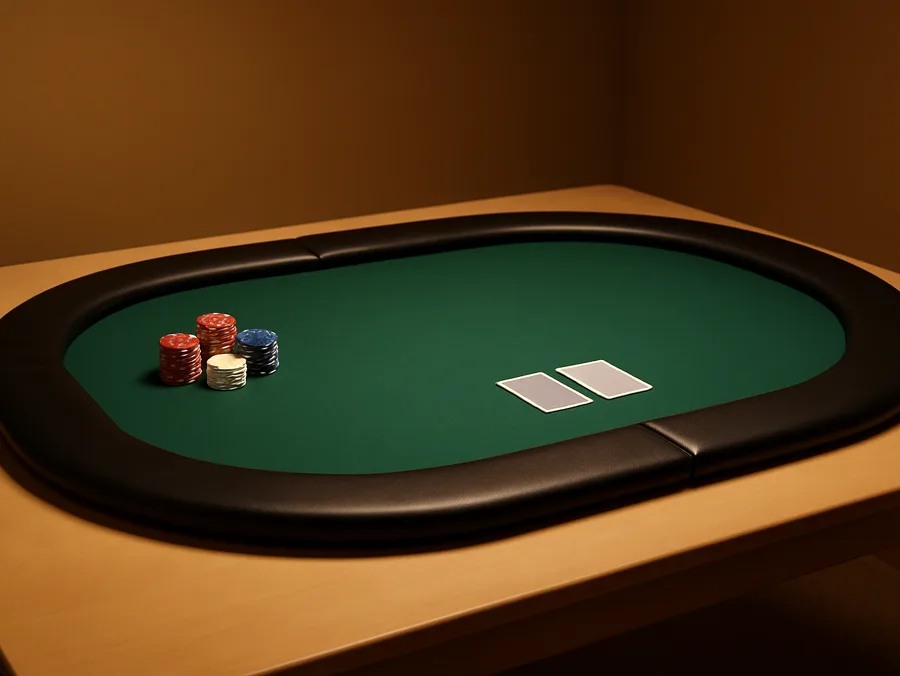
Trademark Solid Wood Folding Poker Table Top
Best poker table topA 78.5 by 36 inch top of 1/2 inch wood under green felt, with 8 removable cup holders, four clip-in chip trays and a Hold'em betting line. It folds to 20 by 36 inches and zips into a nylon carry bag, so it lives in a closet between games.
Check price on Amazon
Barrington 48 in. 8-Player Folding Poker Table
Best foldable poker tableA 48 inch octagon with a velvet surface, a 1 inch faux leather armrest and eight metal cup holders. Powder-coated legs with levelers fold flat to 5.5 inches deep, and the table weighs 47.3 pounds.
Check price on Amazon
DA VINCI 500-Piece 11.5 Gram Clay Composite Chip Set
Chips for up to 10 playersFive hundred 11.5 gram clay composite chips that stack without slipping, in a ding-proof ABS case with two decks of plastic cards, cut cards and dealer and blind buttons.
Check price on Amazon
DA VINCI Ruote 100% Plastic Playing Cards, 2 Decks
Cards that lastTwo poker-size decks of washable 100 percent plastic cards, made in Italy, in a hard case with two cut cards. Paper decks bend and mark; these wipe clean.
Check price on AmazonFrequently asked questions
What is the best poker table for home games?
For most home games, a folding poker table top on your dining table, such as the Trademark 78.5 by 36 inch top. If you need legs, the Barrington 48 inch folding table. A furniture table only makes sense for a weekly game in a dedicated room.
What is the best poker table top?
One that's longer and wider than the table under it, with cup holders and a stable fold. The Trademark wood top seats 8, has chip trays and cup holders, and folds to 20 by 36 inches. Its surface is felt and the listing mentions no padded rail.
Can you put a poker table top on a pool table?
Yes, but put a hard cover or dining top on the pool table first. A 36 inch wide poker top can drop inside a 7 foot table's rails and press on the cloth.
What is the best foldable poker table?
The Barrington 48 inch octagon is a good value pick: velvet surface, 1 inch padded armrest, eight cup holders, levelers, and it folds to 5.5 inches deep at 47.3 pounds.
What size poker table do I need for 8 or 10 players?
Eight fit a 48 inch octagon or a 78.5 inch rectangular top. BBO sizes a 4 by 8 foot oval for 8 to 9 players; for a regular 10, look at large ovals.
Is speed cloth better than felt?
Yes. Cards glide on speed cloth and it resists spills long enough to clean up, while felt slows cards and soaks up drinks. If you keep felt, treat it with a water-repellent spray.
How much does a poker table cost?
Folding tops and folding tables cost a fraction of furniture tables; live Amazon prices show on the cards above. On October 15, 2026, BBO's tables ran from $1,199 on sale to $4,299, and Brunswick's were in its $4,000 to $7,999 bands.
How many chips do I need for a home game?
The Poker Store's guide says a 500-chip set covers a 10-player tournament.
Related guides
LeaguePool is reader-supported. When you buy through links on this site we may earn an affiliate commission at no extra cost to you. As an Amazon Associate we earn from qualifying purchases.