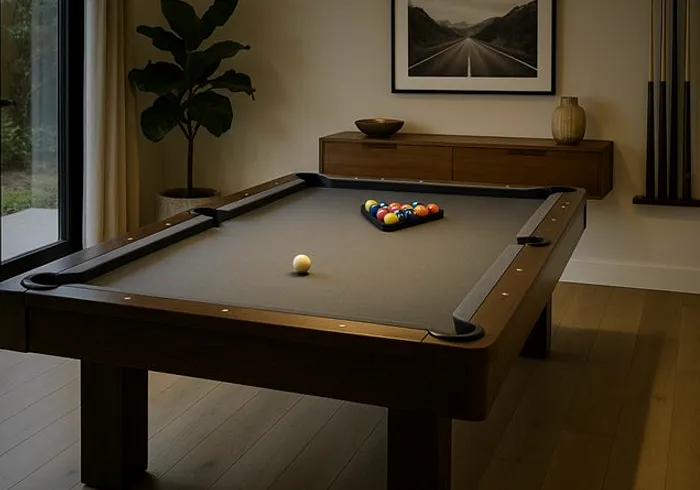
Best Entry-Level Pool Tables
The bottom of the pool table market is where most money gets wasted. Tables at the very cheapest end look like pool tables in photographs and behave like furniture with pockets in practice: beds that are not flat, cushions that absorb energy instead of returning it, and frames that go out of level within a year.
That does not mean you have to spend five thousand dollars. It means you have to know what the non-negotiables are, where the price floor for a genuinely playable table sits, and which compromises are acceptable at the bottom of the market.
The non-negotiables
Three things determine whether a table plays. Everything else is decoration.
1. A flat, stable bed. Slate is flat and stays flat. MDF starts reasonably flat and may not stay that way, particularly in a damp basement or a garage. If a table's bed is not flat, balls curve, and nothing you do afterward fixes it.
2. Cushions that rebound. Real rubber cushions in a correct profile return a ball with energy. Cheap foam or hardened rubber deadens it. Test this by hitting a ball firmly across the table; it should come back well past the rail it started from.
3. A rigid frame. The frame holds the bed level. A frame that flexes or twists means a table you relevel constantly and never quite get right.
Cosmetics, cloth color, pocket style and cabinet finish are all irrelevant to play. A plain table with a flat bed and good cushions beats a beautiful one without them, every time.
What each price bracket gets you
Under $500. Games tables. Thin MDF beds, minimal frames, cushions that barely rebound, often 6ft or smaller. Fine for kids and occasional novelty use. Not tables to learn on and not worth reclothing later.
$500 to $800. Better construction, still MDF, still light. Some are genuinely usable for casual family play. Expect to relevel periodically and expect the bed to respond to humidity.
$800 to $1,500. The realistic entry point. Heavier frames, thicker beds, sometimes thin slate at the top of this range, and cushions that actually work. A table here can be enjoyed for years.
$1,500 to $2,500. Proper slate 7ft tables from established manufacturers appear. This is where a table stops being a purchase and starts being an asset that will last decades.
Used at any of these prices. Frequently the best option, discussed below.
The steepest quality gradient in this whole market is between $500 and $1,200. If your budget is near the bottom, stretching a few hundred dollars buys disproportionately more table.
Why used slate usually wins
Here is the argument that saves most first-time buyers money and disappointment.
Slate does not wear out. A forty-year-old slate bed is as flat as the day it was cut. Frames last decades. The two parts that do degrade, cloth and cushions, are both replaceable at known cost: roughly $200 to $400 for a recloth and $250 to $500 for new cushions.
Used slate tables come up constantly, often cheap, because moving them is a hassle and the seller wants the room back. A used 7ft or 8ft slate table at $500 to $1,000, plus a professional move at $300 to $600 and new cloth, lands around $1,200 to $1,800 total and gives you a table that outperforms anything new at that price by a wide margin.
What to check: slate for cracks and chips, frame for warping or water damage, cushions with the bounce test, and whether all the hardware, rails and pockets are present. Then confirm the table can physically get out of its current room and into yours.
The one thing not to skip is the professional move. Saving $400 by moving slate yourself is how people end up with a cracked slab and a table worth nothing.
Choosing a size
7ft. The default for homes and the size used in bars and most league play. Fits far more rooms, and practice on it translates directly to league night. Needs roughly 16 by 13 feet for full cue clearance.
8ft. Better game, more room needed, roughly 17 by 13.5 feet. The classic home size if the space exists.
6ft and smaller. Fits where nothing else does. The game changes noticeably, cue ball control feels cramped, and skills transfer imperfectly to full-size tables. Still better than no table.
Measure your room first and let the answer come from the tape measure rather than from ambition. Cue clearance, not table footprint, is the limiting number, and short cues can rescue one tight side but not three.
Setup and the first year
An entry-level table needs more attention than an expensive one, and a little of it goes a long way.
Level it properly at setup and check it again after a few weeks once everything has settled. Get a decent level rather than trusting a phone app.
Recheck seasonally. MDF and wood frames move with humidity. Ten minutes with a level twice a year keeps the table honest.
Keep it out of damp and direct sun. Damp is what destroys MDF beds and sunlight fades cloth. A garage that swings from freezing to humid is the worst environment for an inexpensive table.
Cover it. Dust and spills age cloth faster than play does, and a cover costs very little.
Brush, do not vacuum aggressively. A table brush used in one direction keeps the cloth clean without abrading it.
Do those things and a $1,000 table will give you years of good play. Neglect them and the same table is unplayable in eighteen months, which is where the reputation of cheap tables largely comes from.
Our picks
Links open the current selection and price on Amazon so you can compare real reviews before buying.
Barrington Belmont 7 Ft Pool Table
A first real tableThe realistic entry point at $800 to $1,500. Look for a rigid frame, a thick bed and cushions that actually rebound.
Check price on Amazon
Machinist or box level
Setup and seasonal checksEntry-level tables move with humidity. A proper level and ten minutes twice a year is what keeps the table playing true.
Check price on AmazoniEsstros 7 Ft Pool Table Cover with Brush
Making cloth lastDust and sunlight age cloth faster than play does. Brushing in one direction plus a fitted cover doubles the life of a cheap cloth.
Check price on Amazon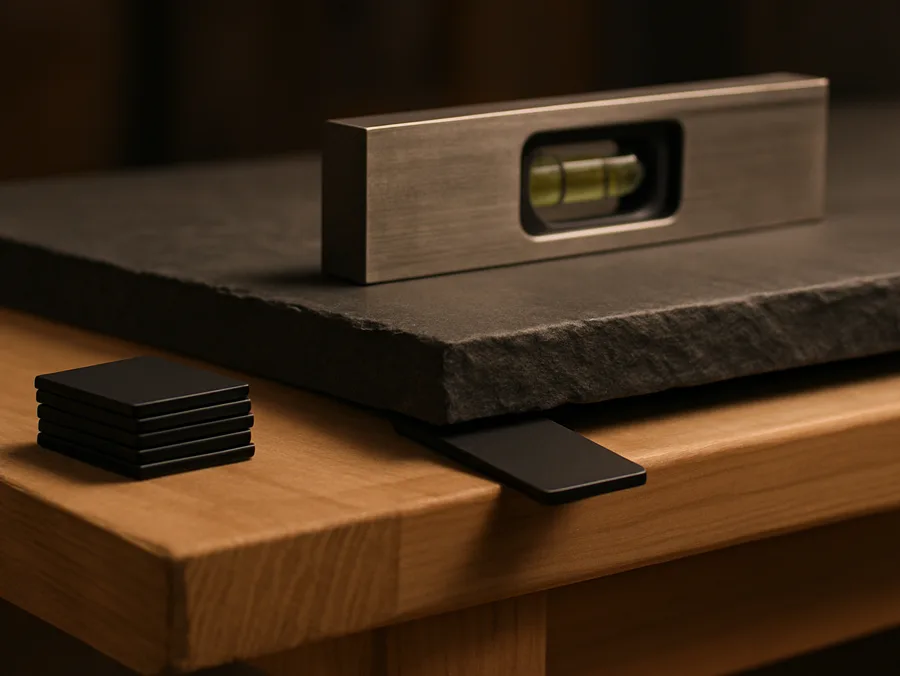
Slate shims
Fine levelingThin shims under legs or between slate sections correct the small drifts that develop as a new table settles into its room.
Check price on AmazonFrequently asked questions
What is the cheapest pool table worth buying?
Realistically, $800 to $1,500 for a new 7ft table with a rigid frame, a thick bed and real cushions. Below about $500 you are buying a games table that will not hold level or rebound properly.
Should I buy a new cheap table or a used slate one?
Used slate, in most cases. Slate does not wear out, and the parts that do, cloth and cushions, are replaceable at known cost. A used slate table plus a professional move and new cloth typically outperforms anything new at the same total price.
Is an MDF pool table any good?
For casual family play, an MDF table in the $800 to $1,500 range is acceptable. It will never roll perfectly true, it responds to humidity, and it needs releveling more often. In a damp basement or garage it will degrade quickly.
What size table should a beginner buy?
7ft, in most homes. It fits more rooms and matches the size used in bars and most league play, so practice transfers directly. Choose 8ft if you have roughly 17 by 13.5 feet of clear space and want a better game.
Related guides
LeaguePool is reader-supported. When you buy through links on this site we may earn an affiliate commission at no extra cost to you. As an Amazon Associate we earn from qualifying purchases.