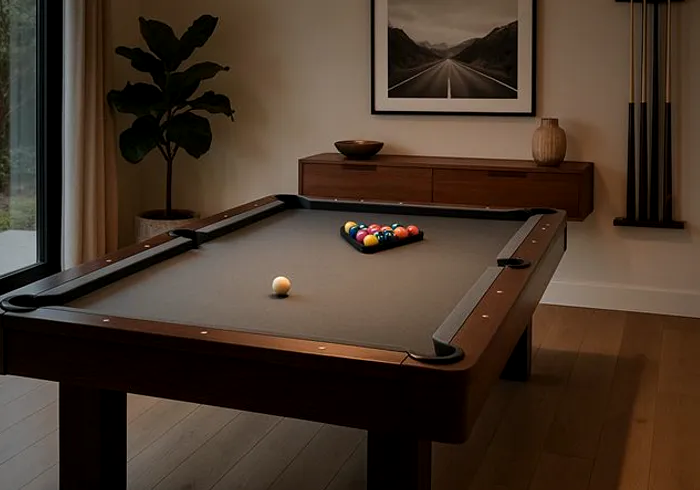
8ft vs 9ft Pool Table: Which Should You Buy?
If you have space for something bigger than a bar box, the real decision is 8 foot or 9 foot. The 9 foot is the professional standard, the size at every major tournament, and practicing on one will genuinely make you a better player. The 8 foot is the classic home compromise: big enough to demand real position play, forgiving enough on room size to fit far more basements. Both are worth owning. Which one is worth owning by you comes down to your room, your goals, and how you feel about long green shots.
The actual size difference
Tables get measured by playing surface, and both sizes keep the same 2 to 1 ratio. An 8 foot table plays 44 by 88 inches. A 9 foot plays 50 by 100 inches. One extra foot of length sounds like nothing on paper. It works out to about 22 percent more playing area, and you feel every bit of it. Shots that are routine on an 8 foot turn into real tests of stroke on a 9 foot, especially long straight-ins and cross-table position routes.
Outer dimensions run bigger than the playing surface because of the rails, usually 10 to 13 inches per side. So the furniture itself is roughly 4.5 by 8 feet for an 8 foot table and about 5 by 9 feet for a 9 foot.
Room requirements with a full cue
Clearance is where most 9 foot dreams die. With a standard 58 inch cue you want close to 5 feet of open space on every side of the playing surface, so you can draw the cue back on rail shots without jabbing drywall. Run that math and an 8 foot table wants a room around 13.5 by 17 feet. A 9 foot wants roughly 14 by 18 feet.
That extra foot in each direction is the whole ballgame. Plenty of basements and garages handle 13.5 by 17 and fall just short of 14 by 18. Measure honestly, and count support posts, radiators, and stair openings against you. A 52 inch cue can shave a few inches off the requirement in one trouble spot. If you need short cues on two or more rails, the room is telling you something.
Why the 9 foot makes you better
Every serious player who moves from a 9 foot down to a smaller table says the same thing: the small table feels easy. The 9 foot punishes a loose stroke. Long shots expose aim errors that a 7 or 8 foot table hides, and position has to be planned in zones instead of bumping the cue ball a few inches. Pattern play, speed control, and straight cueing all develop faster on the big table.
If you play league on 7 foot bar boxes, there is a real argument for practicing on the 9 foot and competing on the small table. The transition down is almost always pleasant. The transition up is not.
Cost, refelting, and resale
New slate tables in both sizes overlap heavily in price. Quality 8 footers commonly run from about $2,000 to $4,500, comparable 9 footers from about $2,500 to $6,000 and up. The gap shows up again in maintenance. Refelting an 8 foot table typically costs $300 to $500 including cloth and labor, while a 9 foot runs $350 to $600 because the cloth pieces are larger and the job takes longer. Moving costs run higher on the 9 foot too, since the slates are heavier.
Resale favors the 8 foot in most residential markets, simply because more buyers have a room that fits one. A used 9 foot can sit on the market a while. Then again, a clean Diamond or Brunswick 9 foot will always find a home with serious players.
Who should buy which
- Get the 9 foot if the room truly fits it, you play regularly, and improvement matters to you. It is the size the game is meant to be played on.
- Get the 8 foot if your space is borderline, the table is mainly for family and guests, or resale flexibility matters. It is still a challenging, satisfying table.
- Do not shoehorn a 9 foot into a room that fits an 8 foot. An 8 foot with full clearance plays better than a 9 foot where half the rail shots need a short cue.
Our picks
Links open the current selection and price on Amazon so you can compare real reviews before buying.
Predator 314 Cue Extension
Reaching shots on a 9 footOn a 50 by 100 inch surface, even tall players end up stretching. A rear extension keeps you down on the shot instead of lunging or reaching for the bridge.
Check price on Amazon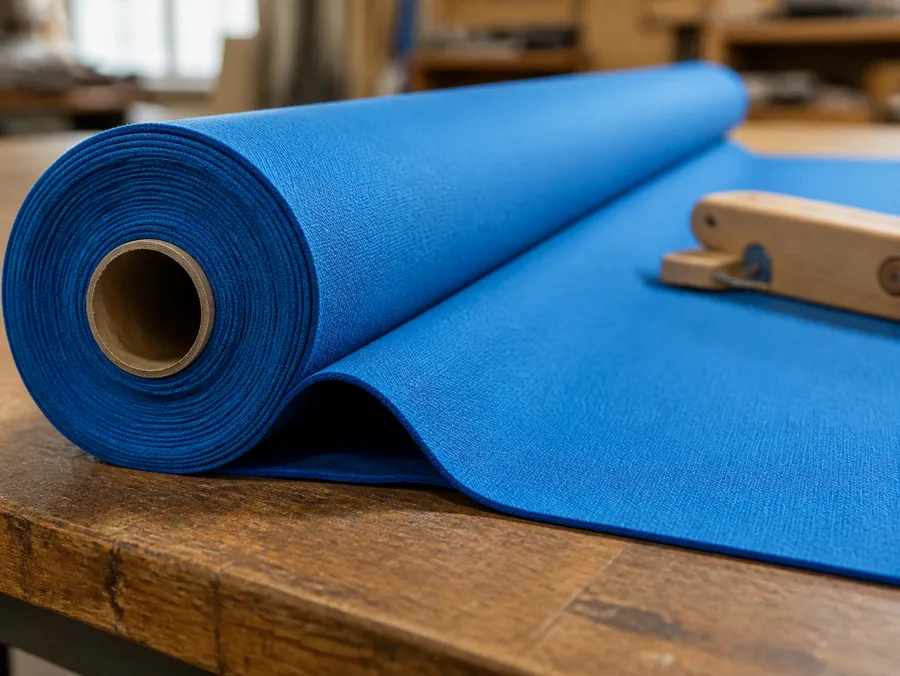
Simonis 860 Cloth
Tournament feel at homeThe worsted cloth used in professional events. If you are buying a 9 foot to train seriously, felt it with the same cloth the tournaments use.
Check price on AmazonCuetec 52 Inch Cue
One tight wall or postA quality short cue solves a single trouble spot in an otherwise workable room without ruining the shot. Keep one in the rack near the tight rail.
Check price on AmazonFrequently asked questions
How much room do I need for a 9 foot pool table?
Plan on roughly 14 by 18 feet of unobstructed space with standard 58 inch cues. That leaves close to 5 feet of clearance on every side of the 50 by 100 inch playing surface.
Do professionals ever play on 8 foot tables?
Major professional events are played on 9 foot tables, which is why it is called the tournament standard. Some leagues and amateur events use 8 foot or 7 foot tables, but the 9 foot is where the pro game lives.
Is a 9 foot table too hard for beginners?
It is harder, not too hard. Beginners miss more long shots at first, but they also build a straighter stroke faster. If the table is shared with kids or casual guests, the 8 foot keeps games moving and frustration lower.
Related guides
LeaguePool is reader-supported. When you buy through links on this site we may earn an affiliate commission at no extra cost to you. As an Amazon Associate we earn from qualifying purchases.