
Are 6-Foot Pool Tables Worth It?
Six foot pool tables sit in an awkward spot in the market. They fit rooms that could never hold a real table. They cost little enough to buy on a whim. And they are just big enough to feel like pool instead of a toy. They are also cramped, almost always MDF instead of slate, and frustrating to anyone who has spent real time on a bar box. Whether one is worth it depends on who is playing and what the alternative is.
The honest version: for kids, for a rec room that doubles as three other things, or for casual family games, a 6 foot table earns its keep. For an adult who wants to actually play 8-ball it is a stopgap, and saving for a 7 foot changes the experience completely.
What you actually get at 6 feet
A 6 foot table usually plays somewhere between 31 by 62 and 33 by 66 inches, roughly two thirds the area of a 7 foot bar box. Nearly everything at this size is MDF or particle board rather than slate, with lighter rails and simpler cushions. That is not automatically a dealbreaker. A flat, well-assembled MDF table is fine for casual games, and the shorter span at this size means MDF sags less than it does on bigger budget tables.
Expect thinner cloth. Pockets run small or oversized depending on the maker. The ball set in the box is often lighter too, since many tables ship with 2 inch balls instead of the regulation 2.25 inch.
The ball congestion problem
Rack fifteen balls on a 6 foot table and the core problem shows up immediately. The balls take up the same space they always do, but the table around them shrank, so after the break everything sits in clumps. A cluster that would be one problem ball on a 7 foot becomes a three-ball pileup here. Runouts turn into bumper pool. Safety play barely exists, because everything is already a safety.
Games with fewer balls on the table, like 9-ball, play noticeably better at this size. Buy a 6 footer and you will probably drift toward rotation games, cut-throat with fewer balls, or drills instead of full-rack 8-ball.
The room math still applies
People buy 6 foot tables because the table fits the room, then discover the cues do not. Clearance is about cue length, not table size. With standard 58 inch cues you still want a room around 12 by 15 feet, even for a 6 foot table. The honest play is to pair a small table with 48 inch cues, which brings the requirement down to roughly 11 by 14 feet. Most 6 foot tables ship with short cues for exactly this reason. Measure your room, subtract the table, and make sure you have at least 4 feet on every side for the cues you will actually use.
Better than nothing, or worse than waiting?
The case for buying now: a 6 foot table gets played. Kids learn stance, bridge, and aim on it. It turns a spare corner into a game corner for well under a thousand dollars, and if it dies in five years you got your money out of it.
The case for waiting: a used 7 foot slate table often sells for $500 to $1,200 locally, plays enormously better, and holds value. If you have the space and can be patient, that is the smarter money. The 6 footer makes sense when the space genuinely cannot fit a 7 foot with clearance, when the main players are under twelve, or when the table has to fold away between sessions.
What to check before you buy
Within the 6 foot class, a few details separate the tables that get played from the ones that get returned. Look for leg levelers first. No floor is flat, and an unlevelable MDF table rolls balls downhill forever. Check the listed weight, because heavier is better at this size: a 180 pound table shrugs off bumps that send a 90 pound table skidding. Read what comes in the box. Ball size varies, and a set of regulation 2.25 inch balls on a 6 footer plays very differently than the 2 inch sets some makers include.
Last one, and the one people skip. Favor tables with real rubber cushions over foam-backed rails. Dead rails are the fastest way to make a small table feel like a toy, and they are the one flaw you cannot fix after purchase.
Our picks
Links open the current selection and price on Amazon so you can compare real reviews before buying.
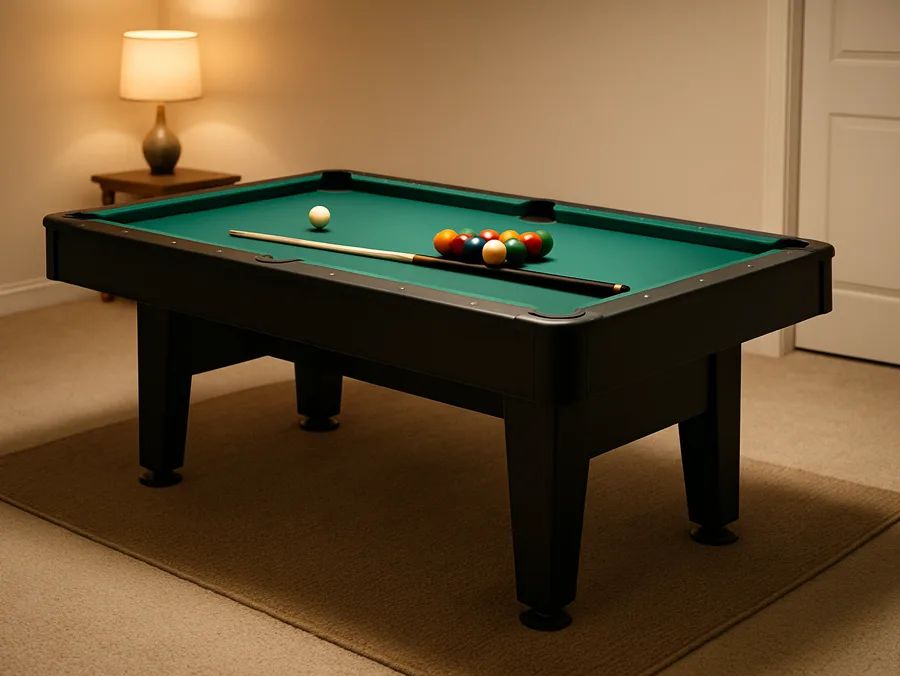
Mizerak Dynasty Space Saver 6.5 Ft
Best overall small tableThe half-foot over a standard 6 footer matters more than you would think, and the leg levelers and decent rails make this the most table-like experience in the class.
Check price on Amazon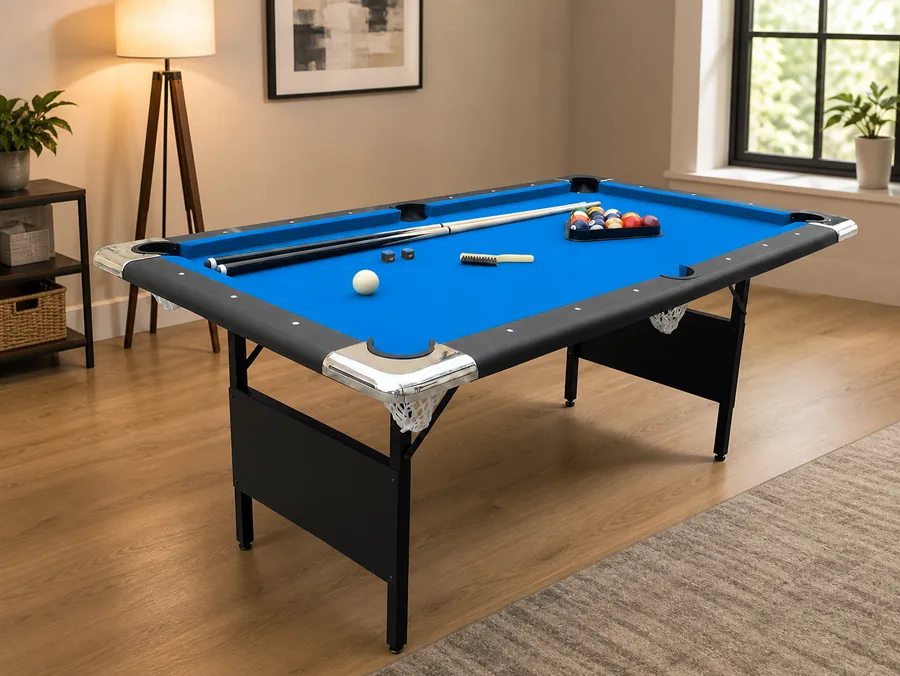
Hathaway Fairmont 6 Ft Folding Table
Multi-use roomsFolds flat on its side between sessions, which is the honest way to put pool in a room that is also an office or a guest room. Ships with short cues sized for tight walls.
Check price on AmazonGoSports 6 Ft Billiards Table
Budget family pickA straightforward MDF table with everything in the box. At this price, assembly care matters more than the badge on the rail, so take your time leveling it.
Check price on AmazonHathaway Crossfire 6 Ft Multi-Game Table
Kids who want varietyFlips between pool and air hockey style play. Neither game is tournament grade, but in a kids playroom the variety keeps it from gathering dust.
Check price on AmazonFrequently asked questions
Can adults play real pool on a 6 foot table?
Yes, though full-rack 8-ball feels congested because fifteen regulation balls crowd a small surface. Games with fewer balls, like 9-ball, play much better. Most adults who play regularly outgrow a 6 footer fast.
Do any 6 foot pool tables have slate?
Almost none. The market at this size is nearly all MDF or particle board, which is fine for casual play if the table is assembled flat and kept dry. True slate generally starts at 7 foot tables.
How much room do I need for a 6 foot pool table?
With standard 58 inch cues, about 12 by 15 feet. With the 48 inch cues most small tables ship with, roughly 11 by 14 feet works. Clearance depends on cue length, not just table size.
Related guides
LeaguePool is reader-supported. When you buy through links on this site we may earn an affiliate commission at no extra cost to you. As an Amazon Associate we earn from qualifying purchases.