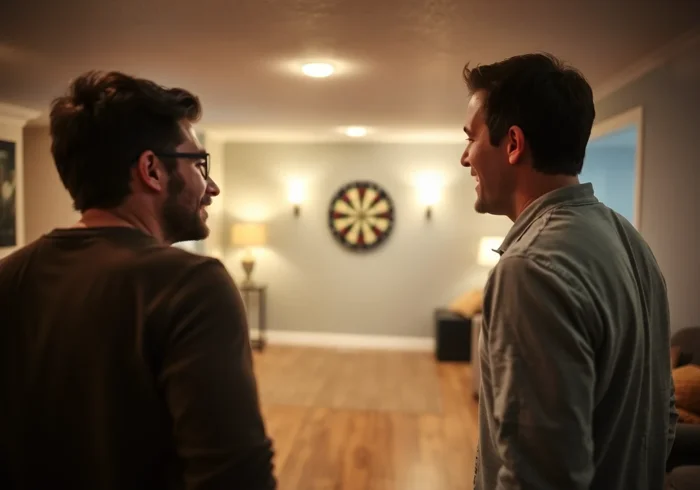
Dart Board Height and Throw Line Distance: Steel Tip and Soft Tip
Hang the dartboard so the center of the bullseye is 5 feet 8 inches (173 cm) above the floor, and put the throw line 7 feet 9 1/4 inches (237 cm) from the face of the board for steel tip darts or 8 feet (244 cm) for soft tip darts on an electronic board. The height is the same for both. Only the distance changes.
Steel tip is the shorter throw and soft tip is the longer one, which is easy to get backwards. Below are the numbers, where each one comes from, how to measure them without a trick, and what to put around the board so the wall and the floor survive.
Dartboard height and throw line distance chart
| Measurement | Steel tip (bristle board) | Soft tip (electronic board) |
|---|---|---|
| Bullseye center to floor | 5 ft 8 in (173 cm) | 5 ft 8 in (173 cm) |
| Throw line from the face of the board | 7 ft 9 1/4 in (237 cm) | 8 ft (244 cm) |
| Diagonal, bullseye center to the oche | 9 ft 7 3/8 in (293 cm) | About 9 ft 9 1/2 in (298 cm) |
The steel tip numbers match the World Darts Federation (WDF) rules. The WDF rulebook text, archived by CyberDarts (third revised edition, March 1995), gives the vertical height from the floor to the bull's center line as 1.73 meters, the distance as 2.37 meters along a horizontal line to a plumb line at the face of the dartboard, and the diagonal from the center of the bull to the back of the oche as 2.93 meters. It also describes a raised oche 38 mm high and 610 mm long. Harrows, which has made darts equipment since 1973, says the same figures are the ones used by the PDC and the WDF, and the same in every country.
The soft tip numbers match the National Dart Association (NDA) requirements for electronic dart machines: 8 ft (96 inches) from the face of the target to the front edge of the foul line, and 5 ft 8 in (68 inches) from the floor to the center of the bull's eye, with a tolerance of plus or minus half an inch. The NDA page says plastic-tip darts and does not use the words soft tip, and it gives no diagonal. The soft tip diagonal in the chart is from DartCounter and Dartscorner. Dr. Patrick Chaplin, a darts historian, notes that some British pubs use other distances, such as 8 ft or 8 ft 6 in for steel tip, so house rules vary.
Measure from the face of the board, not the wall
The number that goes wrong most often is the distance. A board sits a few centimeters off the wall, so if you measure from the wall your throw line ends up too close (Harrows). Measure from the face of the board, along the floor.
A clean way to do it, from Darts Alberta and Harrows:
- Pick a solid wall and a clear stretch of floor. Mark 173 cm (5 ft 8 in) up from the floor. That is where the center of the bull will sit, not the top of the board. Harrows says the top of a standard board sits around 190 cm, about 17 cm above the bull, so measuring to the top puts your whole setup too high.
- Fix the bracket and hang the board with the 20 at the top. Most boards come with a bracket, a center screw and three spring clips. Screw the center screw into the back of the board and seat the spring clips in a triangle so the board does not spin. Check it with a spirit level.
- Drop a plumb line, or a weighted string, from the face of the board to the floor. Darts Alberta describes tying a pencil on a string at the bottom front of the board.
- From that spot on the floor, measure 237 cm (steel tip) or 244 cm (soft tip) straight out and mark the throw line.
- Keep the line square to the board. Darts Alberta says to check it is centered by making sure the distance from the bullseye to each end of the line is equal.
Where the line has some thickness, check which edge your league uses. The 1995 WDF text measures to the back of a raised oche, while the NDA measures soft tip to the front edge of the foul line. Retail guides vary on which edge they name, so when the stakes are a league match, ask the league.
The diagonal check for uneven floors
Thick carpet or an uneven floor can throw a floor measurement off. Harrows suggests a cross-check for steel tip: measure from the exact center of the bull to the back of the oche. It should read 9 ft 7 1/2 in (293 cm). If the straight and diagonal measurements agree, the board is where it should be. Other sources round the same number to 9 ft 7 3/8 in. The soft tip diagonal in Dartscorner's guide is 2.98 m.
Space, wall and floor protection
- Room. Harrows suggests a lane at least 5 feet wide and about 11 feet long, plus at least 60 cm of clear wall on each side of the board. Dartscorner suggests about 1 m by 1 m of wall and at least 1.5 m wide by 3.5 m long of open floor. Keep the board away from windows, doors and anything fragile.
- Wall. A surround, the rubber ring around the board, catches stray darts. A cabinet protects both the wall and the board and often doubles as a scoreboard (Dartscorner).
- Floor. A dart mat marks the throw line for you and protects hard floors. Harrows says bounce-outs on a hard floor can blunt the tip and crack the barrel of your darts, so a mat helps your darts as well.
- Light. A board light reduces shadows and glare (Dartscorner and Harrows).
- Wheelchair players. Harrows says the bull drops to 4 ft 6 in (137 cm) and the throw distance stays at 237 cm.
Brunswick's website adds a fact worth knowing if you are buying a pool table and a dartboard cabinet together: its installation partners deliver but do not install or hang dartboard cabinets, citing liability, so the dart wall is your job.
Fitting a dartboard into a game room or garage
A throw lane about 11 feet long and 5 feet wide is a lot of floor next to a pool table. Cue clearance around a table already eats the room, so work out both before you pick a wall. Our room size guide has the pool side, and the room and basement pages have layouts that share the floor: pool table room ideas and basement pool table ideas. A practical rule of our own, not a published one: keep the throw lane out of the area where someone is swinging a cue, and hang the board on a wall with nothing fragile within the flight path.
If you have not bought the board yet, our best dart boards guide covers sisal bristle boards, cabinets and mats, and the accessories checklist covers the rest of a game room.
Sources
- World Darts Federation Playing and Tournament Rules, third revised edition, 1995 (archived by CyberDarts; clauses 4.03, 6.01 and 6.02)
- Harrows: how to set up a dartboard
- Darts Alberta: dartboard set-up
- CyberDarts: darts basics (steel tip and soft tip setup)
- Dartscorner: how to hang a dartboard
- Dr. Patrick Chaplin: the standard dartboard set-up
- National Dart Association: NDA rules (soft tip throw line and board height)
- Brunswick: shipping and returns
Our picks
Links open the current selection and price on Amazon so you can compare real reviews before buying.

Winmau Blade 6 Dartboard
A board that hangs levelA sisal bristle board with a Rota-Lock bracket that has a built-in level, so the board hangs straight and holds its position while you work out the 173 cm mark. Add a surround or backboard to protect the wall.
Check price on Amazon
Target Darts World Champions Dart Mat
Marking both throw linesA rubber-backed mat with steel tip and soft tip throw lines marked at tournament distances. Position it off a plumb line from the board face and the oche is set, and it protects the floor and your dart points.
Check price on Amazon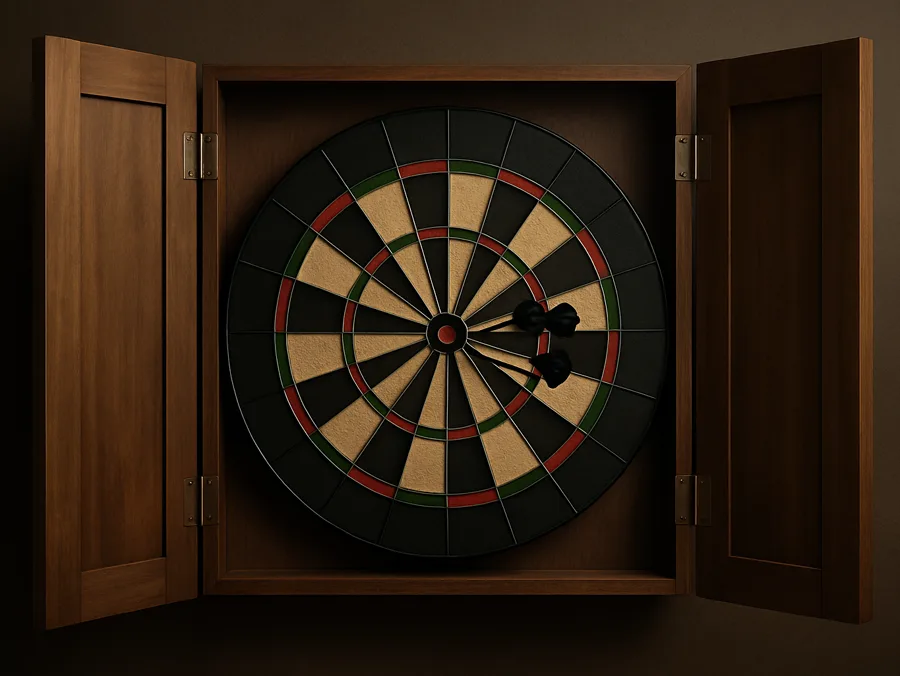
Viper Stadium Cabinet and Shot King Bristle Dartboard
Wall protection in one boxA sisal board inside a cabinet whose doors close over the board and work as a scoreboard. The cabinet shields the wall behind the board, and a stick-on throw line is included.
Check price on AmazonFrequently asked questions
How high should you hang a dartboard?
The center of the bullseye should be 5 feet 8 inches (173 cm) from the floor, for both steel tip and soft tip boards. Measure to the center of the bull, not the top of the board.
How far is the throw line from the dartboard?
7 feet 9 1/4 inches (237 cm) for steel tip darts, and 8 feet (244 cm) for soft tip darts on an electronic board. Measure along the floor from the face of the board, not the wall.
What is an oche?
The oche is the throw line you stand behind. The WDF rules describe a raised oche 38 mm high and 610 mm long. At home, a mat or a strip of tape does the same job.
Is the soft tip distance different from steel tip?
Yes. Soft tip on an electronic board is thrown from 8 feet, which is a little farther than the 7 feet 9 1/4 inches used for steel tip. The bullseye height is the same for both.
How do I check my dartboard setup is correct?
Measure the diagonal from the center of the bull to the oche. For steel tip it should be 293 cm under the WDF rules, which Harrows gives as 9 feet 7 1/2 inches. If the floor distance and the diagonal agree, the setup is right.
How much space do I need for a dartboard?
Harrows suggests a lane at least 5 feet wide and about 11 feet long, with 60 cm of clear wall on each side of the board. Dartscorner suggests about 1.5 m wide by 3.5 m long of floor.
Related guides
LeaguePool is reader-supported. When you buy through links on this site we may earn an affiliate commission at no extra cost to you. As an Amazon Associate we earn from qualifying purchases.