Best Pool Cues for Kids: Children's Cue Sizes by Age
Most kids need a 42, 48 or 52 inch pool cue, not a cut-down adult one! McDermott, one of the few major cue makers with a youth line, sizes its 42 inch cue for ages 7 to 10 and its 52 inch cue for ages 11 and up. Children's cues are lighter as well as shorter: GSE's shorties weigh 12 ounces at 36 inches and 18 ounces at 52, against about 19 for an adult cue.
Below: a size chart by age and height, the quick fit check at the table, what tip and build to look for, the best kids' pool cues for each age, and when to move a child up to a full 58 inch cue.
Kids' pool cue size chart
Two cue sellers publish youth sizing, and they line up well. McDermott goes by age; PoolDawg, a large online cue retailer, goes by height. We merged them.
| Child | Height (roughly) | Cue length | Typical weight |
|---|---|---|---|
| Under 7, or a first try | Under 4 ft | 36 in | 12 to 15 oz |
| Ages 7 to 10 | 4 ft to 4'6" | 42 in | 14 to 17 oz |
| Tall 8 to 10 year olds | Up to 4'8" | 48 in | 15 to 18 oz |
| Ages 11 and up | 4'8" to 5 ft | 52 in | 17 to 18 oz |
| Teens and adults | 5 ft and taller | 58 in (standard) | 18 to 21 oz |
Weights come from real listings..... GSE's one-piece shorties are 12 oz at 36 inches, 14 at 42, 15 at 48 and 18 at 52; AB Earth's are 15 oz at 36, 17 at 42 and 18 at 48; McDermott's shorty house cues are 15 oz at 42, 16 at 48 and 17 at 52. The heights in the first rows are our estimate for the ages; PoolDawg's chart only starts at 48 inches for anyone under 4'8".
The sources disagree slightly in one spot. McDermott puts ages 7 to 10 on a 42 inch cue, while PoolDawg's chart would hand any child under 4'8" a 48. Use 42 for an average 7 or 8 year old and 48 for a tall 9 or 10 year old, then check at the table.
What size pool cue for an 8 year old?
A 42 inch cue. That's what McDermott recommends for ages 7 to 10, and at 14 to 17 ounces it's light enough for an 8 year old to stroke without lunging. If your 8 year old is tall for their age, or you'd rather buy once for the next three years, a 48 inch cue works too, as long as the fit check below passes.
The 30-second fit check
Stand the cue on its bumper next to the child. For a first rough check, the tip should land somewhere between the chin and the shoulder. Then try it at the table, which is what really counts:
- Have the child bend over a shot with a hand bridge on the cloth and hold the cue at the back of the wrap.
- With the tip just behind the cue ball, the grip-hand forearm should hang about straight down. Dr. Dave Alciatore gives the same rule for adults.
- If the grip hand is jammed against the bumper or the elbow is bent way back, the cue is too short. If the hand ends up near the joint with lots of butt behind it, or the back of the cue bumps the child's body, it's too long.
- Watch a few strokes. A child who sways the whole body or swings the cue sideways is usually fighting too much length or weight.
Most kids' shots are short of a full stretch anyway. A mechanical bridge handles the far side of the table better than any cue length.
Weight: lighter is the point
Adult cues run 18 to 21 ounces, with 19 the most common. That's a lot of stick for a young child. Children's cues get lighter mostly by getting shorter, which is why a 36 inch shorty can weigh 12 ounces. Look for the weight in the listing and favor the lighter end for younger kids. A child should be able to hold the cue level with a relaxed grip and swing it without the shoulder doing the work.
Some youth cues, including McDermott's, have an adjustable weight bolt, so weight can go up a little as the child grows. Most cheap shorties don't. Adult weights are covered in our cue weight guide.
What to look for in a children's pool cue
- A glued-on leather tip. GSE uses a 12mm layered leather tip, AB Earth a 12.5mm medium leather tip and McDermott's youth cues 13mm. Avoid the hard screw-on plastic tips on the cheapest sticks: they skid, won't hold chalk and teach a child that miscues are normal. More in our cheap cue picks.
- Real wood or a durable composite. Maple plays better. Fiberglass and composite cues survive being dropped and leaned on, which counts for a lot in a house with kids. See fiberglass vs graphite vs wood cues.
- One-piece or two-piece. One-piece shorties like the GSE are cheap and have no joint to loosen. Two-piece youth cues, such as McDermott's with a 3/8-10 joint or HMQQ's quick-release cues, fit in a case and come along to the hall. Our comparison of one-piece and two-piece cues covers the trade-offs.
- A rubber bumper. It protects floors and the butt when a kid stands the cue up, which they will.
For the youngest players: a cue with the ball attached
For a prescholer who mainly wants to hit balls, there's a gentler option. McDermott sells a 42 inch training cue with a full-size cue ball fixed to the tip end, and PoolDawg carries junior cues with a ball attached. The child pushes the attached ball into the object ball, so there are no miscues and no chance of tearing the cloth. It's a toy-like first step, and most kids are ready for a real 36 or 42 inch cue within a season. If you have older players learning cue ball control, our guide to training cue balls is a different thing entirely.
Our picks compared
| Cue | Lengths and weights | Tip | Build | Best for |
|---|---|---|---|---|
| GSE Shorty | 36 in 12 oz, 42 in 14 oz, 48 in 15 oz, 52 in 18 oz (and 58 in 20 oz) | 12mm layered leather, glued on | One-piece Canadian maple | The lightest cue at each length |
| AB Earth Short Cue | 36 in 15 oz, 42 in 17 oz, 48 in 18 oz | 12.5mm medium leather | Canadian maple shaft, hardwood butt, 5/16x18 joint | A kid who wants a cue that looks like a grown-up's |
| HMQQ 2-piece cues | 42 or 48 in (or 58), 17, 18 or 20 oz | 13mm "fiber leather" | Two-piece solid hardwood, quick-release joint | Siblings sharing a set; 1-year warranty |
| McDermott youth cue (retailers) | 42 in (ages 7 to 10), 52 in (11 and up) | 13mm | Two-piece, 3/8-10 joint, Irish linen, weight bolt | A serious junior player; three-year limited warranty |
McDermott's youth cues are sold through its dealers rather than as an Amazon listing we could verify, so they have no card below.. HMQQ describes its tip as "fiber leather" and its wood as "solid hardwood" without saying more, which is fine for a family set but not what we'd buy for a kid who plays every week.
Safety around the table
A cue is long and has a hard end, and kids swing things. Three habits cover most of it: tip down and pointed at the table when not shooting, a full cue length of space around whoever is shooting, and no climbing on the table to reach a shot. Climbing is also how rails and cloth get damaged. A properly sized cue helps on its own, because a child who isn't stritching keeps both feet on the floor.
When to move up to a full-size cue
At about 5 feet tall. PoolDawg's chart puts everyone from 5 feet to 6'4" on a standard 58 inch cue, so a 12 or 13 year old who has hit 5 feet is ready for an adult cue. Go to the standard 19 ounce weight or one lighter, and see our beginner cue guide for the first adult cue. Length questions for every age are covered in what size pool cue do I need.
The kids' cue doesn't have to retire!! A 48 or 52 inch cue is exactly what adults reach for when a wall is too close to the table, so it earns its spot in the rack for years. That's how A.E. Schmidt and McDermott both pitch short cues: for youth players and for small rooms.
Sources
- McDermott: Youth pool cues
- McDermott: K91B 42 inch youth cue (ages 7 to 10)
- McDermott: K91C 52 inch youth cue (ages 11 and up)
- McDermott: 42 inch training cue
- McDermott: HCC shorty house cues
- PoolDawg: Beginner's guide to pool cues (height chart)
- PoolDawg: Junior and children's pool cues
- A.E. Schmidt: Space and dimensions
- Dr. Dave Alciatore: Cue length FAQ
Our picks
Links open the current selection and price on Amazon so you can compare real reviews before buying.
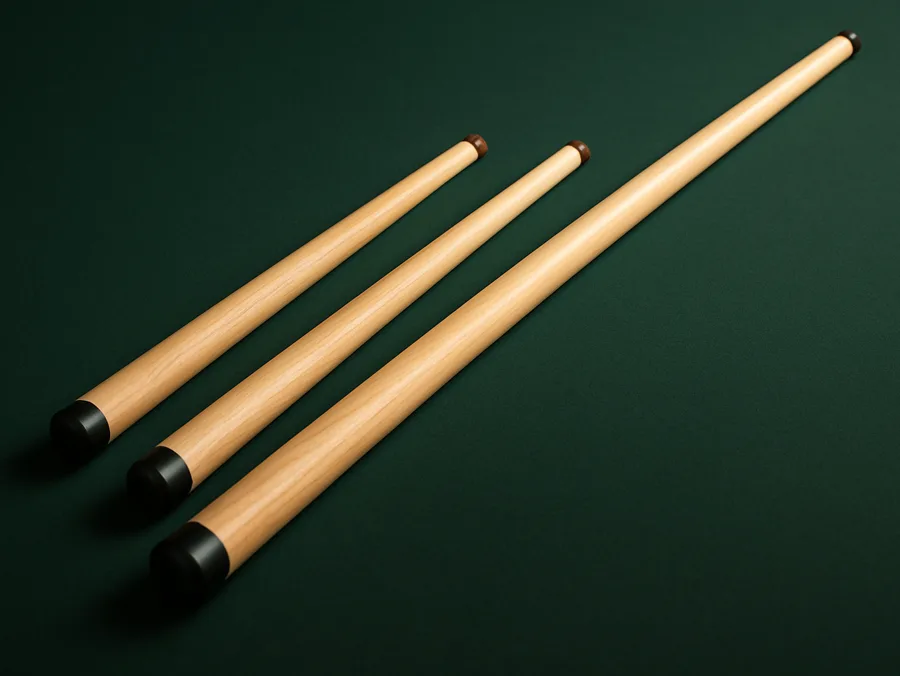
GSE One-Piece Shorty Cue, 36 to 58 in
Most kidsFive lengths on one listing, each at its own weight: 36 inches at 12 oz, 42 at 14, 48 at 15 and 52 at 18. Canadian maple, a 12mm glued-on layered leather tip and a rubber bumper. Order the length from the chart, not the one the child will grow into.
Check price on Amazon
AB Earth Short Pool Cue for Kids, 36/42/48 in
A real-looking two-piece cueBuilt like a small adult cue: Canadian maple shaft, hardwood butt, a 5/16x18 joint and a 12.5mm medium leather tip, with a wrapless handle. It runs heavier than the GSE (15 oz at 36 inches, 17 at 42, 18 at 48), so it suits kids at the upper end of each size.
Check price on Amazon
HMQQ 2-Piece Cues, 42/48/58 in, 2 or 4 Pack
Families and siblingsChoose 42 or 48 inch cues for kids (or 58 for the adults) at 17, 18 or 20 oz, in packs of two or four. Quick-release joints, rubber bumpers, a 13mm tip and a 1-year warranty. The listing calls the wood solid hardwood rather than maple, so treat these as a family set rather than a serious junior's cue.
Check price on AmazonFrequently asked questions
What size pool cue does a child need?
About 36 inches under age 7, 42 inches for ages 7 to 10, 48 inches for tall 8 to 10 year olds and 52 inches from about age 11 or 4'8". At 5 feet tall a child can use a standard 58 inch cue.
What size pool cue for an 8 year old?
42 inches for most 8 year olds, which is McDermott's size for ages 7 to 10. A tall 8 year old can use 48 inches.
How much should a kids' pool cue weigh?
About 12 to 18 ounces depending on length. GSE's shorties, for example, are 12 oz at 36 inches, 14 at 42, 15 at 48 and 18 at 52.
Can a child just use an adult cue?
Not well. A 58 inch, 19 ounce cue is too long and heavy for most children and forces a lunging, sideways stroke. Use a short cue until the child is about 5 feet tall.
Can I cut down an adult cue for a kid?
Cutting the butt leaves you with a cue that's still heavy for its length, has no bumper and is badly balanced. A shorty cue costs about as little and plays properly.
At what age can a kid start playing pool?
As soon as they can see over the rail with a cue that fits. Very young children can start with a cue that has the ball attached, then move to a 36 or 42 inch cue.
Are kids' pool cues useful for adults?
Yes. A 48 or 52 inch cue is the standard fix for shots where a wall or post is too close to the table.
Related guides
LeaguePool is reader-supported. When you buy through links on this site we may earn an affiliate commission at no extra cost to you. As an Amazon Associate we earn from qualifying purchases.