
How to Aim in Pool: Step-by-Step Billiards Aiming
To aim a pool shot, find the line from the center of the pocket through the object ball, then send the cue ball to the spot it has to occupy when it touches the object ball. That spot is called the ghost ball. Its center sits on the pocket line, one ball width beyond the object ball's center. Aim the center of the cue ball at the center of that ghost: not at the object ball, and not at the contact point on its surface.
The geometry takes two minutes to learn... Making it repeattable is the real work: seeing the line while you're still standing, getting down without losing it, and stroking straight along it. This page covers that routine, the cut-angle numbers worth memorizing and how to work out why a shot missed.
How to aim in pool, step by step
- Stand behind the object ball and look along the line from the center of the pocket through the center of the ball. Where that line leaves the back of the ball is the contact point. Dr. Dave Alciatore's shortcut: it's the point on the object ball farthest from the pocket.
- Picture the ghost ball, a cue ball frozen against the object ball at that contact point. Its center is on the same line, one ball diameter (2-1/4 inches on standard balls) from the object ball's center.
- Walk back behind the cue ball. The line from the center of the cue ball to the center of the ghost ball is your aiming line.
- Stand on that line with your vision center over it and set your feet. (The stance guide covers finding your vision center.)
- Drop straight down into your stance with your eyes on the target, bringing the bridge hand and cue down onto the line.
- Once down, hold the cue still and move your eyes between the tip and the target. If the line looks off, fix it the way Dr. Dave describes: rotate the cue and shift the bridge hand together. Moving only one of them changes where the tip meets the cue ball.
- Pause at the end of your warm-up strokes, lock your eyes on the target, and deliver a straight stroke.
That's the whole process. Steps 2 and 3 are the ghost ball method, which has its own page with drills: ghost ball aiming.
Do your aiming standing up
The most useful idea in Dr. Dave's Billiards Digest column "How Pros Aim" (February 2024) is also the least glamorous: pros aim while they're standing, before they get into their stance. From a higher viewpoint the angle of a shot is much easier to see; down at cue level it's hard to see at all. So trust the aim you saw standing, and if the line looks wrong once you're down, stand up and start again instead of re-aiming from the stance!
He jokingly named the routine DAM (Dave's Aiming Method) to poke fun at aiming-system marketing, but the steps are real: look down the object-ball-to-pocket line first, walk back to the cue ball keeping your eyes on the ghost-ball spot, line up your vision center, drop straight down with your eyes on the target so the shot picture never changes, then check, pause and lock your eyes on the object ball for the final stroke.
The aiming mistakes that cost the most balls
| Mistake | What happens | Fix |
|---|---|---|
| Aiming the cue ball's center at the contact point | The cue ball hits the object ball much too full; cuts miss on the thick side, badly on thin cuts | Aim at the ghost ball's center, half a ball width beyond the contact point |
| Aiming at the center of the object ball on a cut | A full hit sends the object ball straight ahead, nowhere near the pocket | Start every shot from the pocket line, not from the ball |
| Putting the ghost ball on the pocket side of the object ball | Everything comes out backward | The ghost sits on the far side, touching the ball opposite the pocket |
| Re-aiming once you're down | You lose the clear standing view and start guessing | Get up and start over if the line looks wrong |
| Steering the cue at the last moment | Adds sidespin you didn't plan | Fix the bridge position before the stroke, then stroke straight |
| Looking at the cue ball at contact | The final stroke drifts off the line | Eyes on the object ball target for the final stroke |
The first one is the big one. Dr. Dave's May 2026 column says aiming directly at the contact point makes the cue ball hit the object ball at a very different point and "miss badly." If your cuts keep missing thick, check this before anything else.
Cut angles: three numbers worth memorizing
How much of the object ball the cue ball covers at contact decides the cut angle.. Three reference hits are worth knowing cold:
- Three-quarter-ball hit: aim the cue ball's center at a point halfway between the object ball's center and its edge. Cut angle about 15 degrees.
- Half-ball hit: aim the cue ball's center at the object ball's edge. Cut angle 30 degrees. This is the easiest reference on the table to see.
- Quarter-ball hit: aim a quarter ball outside the edge. Cut angle between 45 and 50 degrees.
The rule behind them is tidy: the sine of the cut angle equals one minus the fraction of overlap. Every real shot lands near one of these or between two of them, so they're good checks on what your eye tells you. The full table, and how players turn these references into a system, is in pool aiming systems compared.
Your eyes: vision center beats dominant eye
You can aim perfectly and still miss if your head sits off to one side of the cue, because a straight line then looks bent. Dr. Dave's position is that your personal vision center, the head position where a straight shot looks straight, counts for much more than which eye is dominant. For some players it's the dominant eye over the cue; for him (right-eye dominant) it's the cue under the nose.
The test takes ten minutes with long straight-in stop shots and is laid out in pool stance basics. Left-handed players: don't assume your eye flips with your hand. Test it (more in the left-handed guide).
Throw: why a perfect aim can still hit a little thick
The ghost ball geometry assumes the object ball leaves exactly along the line through the two balls' centers. Friction between the balls drags it slightly toward the direction the cue ball is moving. That's cut-induced throw, and it makes a perfectly aimed cut go a hair thick.
Dr. Dave's advice: on most shots, especially short ones on generous pockets, ignore it. On slow stun shots near or thinner than a half-ball hit, slow rolling shots and frozen combinations, overcut slightly (aim a little thinner). Maximum throw is about 1 inch per foot of object ball travel, roughly 5 degrees, and follow or draw cuts it down a lot. The ghost ball page has a table of which shots throw the most: the ghost ball guide.
Aiming with english
Sidespin doesn't change where the ghost ball is, except for the throw it adds. It changes the cue ball's route to the ghost: the ball squirts away from the side you hit and, with a raised cue, swerves back. So learn to pocket balls with a center-ball hit first. When you start using english, aim it with back-hand or front-hand english, both explained in the english guide. A low-deflection shaft makes the correction smaller but doesn't remove it.
Why you missed: a quick diagnosis
Dr. Dave's list of the most common reasons people miss shots they should make starts with the boring one: not enough care and focus on visualizing and aiming the shot. Then come careless cue and tip alignment, a vision center that's off, not adjusting for squirt, swerve and throw, and a poor stroke. Match your miss pattern to the likely cause:
| Miss pattern | Likely cause | Where to fix it |
|---|---|---|
| Straight-in shots miss to the same side | Vision center or alignment | Stance and vision center |
| Slow cuts miss thick, firm ones go | Cut-induced throw | Overcut slightly on slow shots |
| Misses only when you use english | Squirt and swerve | Aiming with english |
| Thin cuts miss thick, every time | Aiming at the contact point instead of the ghost | Ghost ball method |
| Random misses both ways | Rushed routine or a stroke that wanders | Building a straight stroke |
| The cue ball isn't hit where you aimed (unwanted spin) | Bridge placed off the line, then steering to fix it | Grip and bridge |
That last row deserves a word. Colin Colenso, quoted on Dr. Dave's site, argues that many "stroke problems" are really bridge placement problems: if the bridge lands a millimeter or two off the line... the player feels it and steers, then blammes the stroke. Setting the bridge exactly on the line is part of aiming.
Four drills that build aim
- The partner ghost-ball drill. From Dr. Dave's drill sheet: a partner sets a striped object ball with its number on the contact point and the stripe pointing at the pocket. You aim and hold your set position. The partner places a second striped ball at the ghost-ball spot, you adjust if needed, the partner removes it, you shoot. Repeat at different angles and distances.
- Long straight-in stop shots. The simplest honest test of alignment and stroke. If the cue ball doesn't stop dead and the object ball isn't center pocket, something in your setup is off.
- The three reference cuts. Set up the three reference cuts (three-quarter, half, quarter) into the same corner and shoot each ten times. Mark the ball positions with marker dots so every attempt is identical.
- One cut, three speeds. Shoot the same half-ball cut soft, then firm. The soft ones will hit thick if you don't overcut, which teaches you throw faster than any explanation.
The practice drills page has more routines.
Aiming kicks and banks
Rail shots use other tools..... Kicks: kick shot guide (aim at the ghost-ball spot if you want to pocket the ball). Banks: bank shot guide. The numbered systems: the diamond system explained. And the same ghost-ball geometry works in snooker and in carom billiards; only the ball size changes.
Sources
- Dr. Dave Alciatore: aiming tutorial
- Dr. Dave, How Pros Aim (Billiards Digest, February 2024, PDF)
- Dr. Dave, Aim Visualization Techniques (Billiards Digest, May 2026, PDF)
- Dr. Dave: ghost-ball aiming method and drill (PDF)
- Dr. Dave: why people miss shots
- Dr. Dave: throw tutorial and maximum throw
- Dr. Dave: fractional-ball aiming
- Dr. Dave: dominant eye and aiming
Our picks
Links open the current selection and price on Amazon so you can compare real reviews before buying.

MOOCY 6-Dot Measle Training Cue Ball
Seeing the aiming line on real shotsA regulation 2-1/4 inch, 6 oz phenolic cue ball with six red dots embedded in it. Dr. Dave suggests lining up the dots on a measle ball with the line of the shot while you practice, which makes the aiming line visible on real shots. It's sized for pool, not snooker.
Amazon price: $12.99 as of 7:00 AM EST. Price and availability can change; Amazon’s price at purchase applies.
Check price on Amazon
Pool Table Marker Dots, 240 Pack
Setting up the same shot every timePeel-and-stick 35mm spots that grip the cloth and come off clean. Stick one under each ball (and one at the ghost-ball spot) and you can repeat an aiming drill fifty times with nothing changing except you. With 240 in the pack, you won't run short.
Amazon price: $7.48 as of 7:00 AM EST. Price and availability can change; Amazon’s price at purchase applies.
Check price on Amazon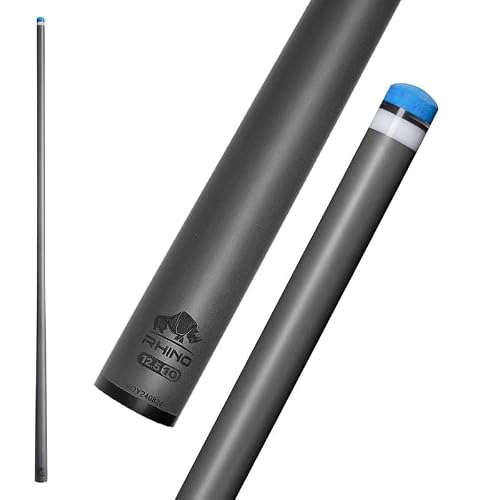
RHINO 12.5 mm Carbon Low-Deflection Shaft (3/8-10)
Smaller aim corrections when you use englishThis applies only once you play with sidespin. A low-deflection carbon shaft squirts the cue ball off line less, so the correction you make for english shrinks. The listing describes a 30-inch pro taper shaft of about 4 oz with a 3/8-10 stainless joint, so check that joint against your butt before ordering. For center-ball aiming it changes nothing.
Amazon price: $162.28 as of 6:48 AM EST. Price and availability can change; Amazon’s price at purchase applies.
Check price on AmazonFrequently asked questions
How do you aim in pool as a beginner?
Find the contact point on the object ball, the point farthest from the pocket. Picture a cue ball touching the object ball there (the ghost ball) and aim the center of your cue ball at the ghost's center. Practice it on straight-in and half-ball shots before anything harder.
Should I aim at the contact point on the object ball?
Not with the center of the cue ball. Aiming the cue ball's center at the contact point makes it hit too full, and the shot misses thick. Aim at the ghost ball's center, which is half a ball width beyond the contact point on the pocket line.
Where should I look when I shoot, the cue ball or the object ball?
Check the cue ball and tip during your warm-up strokes, pause, then look at the object ball target for the final stroke. Top players lock their eyes on the target before the last stroke, as Dr. Dave describes.
What is a half-ball hit in pool?
A shot where the center of the cue ball is aimed at the edge of the object ball, so half of one ball overlaps the other at contact. It cuts the object ball at 30 degrees and is the easiest reference angle to see.
Why do I keep missing cut shots on the thick side?
Two common causes. You may be aiming at the contact point instead of the ghost ball, which always hits too full. Or it's throw: on slow cuts, friction drags the object ball toward the cue ball's direction, so overcut slightly.
Do pros use an aiming system?
Most don't use a step-by-step system. Dr. Dave's view is that they aim by feel built from huge amounts of practice, using a consistent routine: aim standing, drop straight into the shot, check alignment, lock eyes on the target.
Is aiming different in billiards and snooker?
No. The geometry is the same in pool as in snooker or carom billiards: send the cue ball to the ghost-ball spot on the line from the target through the object ball. Only the ball size and pocket size change how much error you can get away with.
Related guides
LeaguePool is reader-supported. When you buy through links on this site we may earn an affiliate commission at no extra cost to you. As an Amazon Associate we earn from qualifying purchases.