Pool Stance: Feet, Head Height and Alignment
A good pool stance does four things: it holds you still, it puts your eyes on the line of the shot, it leaves room for your arm to swing straight, and you can repeat it on every shot without strain. Feet about shoulder-width or wider, back foot near the shot line, weight spread between both feet and a little on the bridge hand, head low over the cue. That's the textbook version, and it's a starting point, not a rule.
Dr. Dave Alciatore, a PBIA Master Instructor who has written about stance for Billiards Digest for years, puts it bluntly: the best stance varies a lot with height, flexibility and body shape. So this guide gives you the standard setup, then the tests that tell you whether your version works.
The textbook pool stance, step by step
For a right-handed player (left-handers mirror everything):
- Stand a step behind the cue ball and look down the shot line through the cue ball to where you want it to hit the object ball.
- Step in with your right foot so the ball of the foot sits on or close to that line. Turn the foot out somewhere between 45 degrees and square to the line, whatever is comfortable for your hips.
- Step your left foot forward and out to the left, at least shoulder-width from the right, pointing roughly toward the shot.
- Lock or nearly lock the back knee. The front knee can be straight or slightly bent.
- Bend forward from the waist until your chin is close to the cue, and lay your bridge hand on the cloth with the bridge arm extended.
- Check that your feet and bridge make a tripod: a little weight on the bridge hand, the rest split between your feet.
- Let your grip arm hang so the forearm is vertical when the tip reaches the cue ball, with clearance between your arm and your body.
That's the textbook setup from Dr. Dave's December 2019 Billiards Digest article and his fundamintals checklist. The details below explain which parts matter most and which you can bend.
Feet and weight: what counts and what doesn't
The back foot on the shot line is the most repeated piece of stance advice, and it's a fine place to start. It's also less important than people think. Dr. Dave calls the strict version mostly dogma: depending on how open your stance is, how tall you are and whether you're pigeon-toed or duck-footed, the back foot can sit well inside or outside the line and still work. What has to be right is stability and a free, straight stroke...
On weight, instructors give slightly different numbers. McDermott's Anthony Beeler teaches about 60 percent on the back foot and 40 on the front. Dr. Dave's description is a little weight on the bridge hand and the rest shared about equally between the feet. Both agree on the part that counts: you shouldn't be leaning on the bridge hand so hard it moves, and nothing should shift when you stroke.
A quick stability test: once you're down, have a friend give your shoulder a light push. If you rock, widen your feet or bend the front knee a little more. Beeler adds one rule worth keeping: the front foot moves up, out or diagonally, never back behind the back foot.
How low to get: head height
As low as you can hold comfortably. Watch a pro snooker match and you'll see chins resting almost on the cue; plenty of top pool players do the same. Dr. Dave lists the reasons a low head helps:
- It's easier to see, or even feel, when your head is off to one side of the cue.
- You sight down the cue like a rifle barrel, which makes the line of the shot easier to see.
- Your eyes travel less between the cue ball and object ball.
- Tip height on the cue ball (for draw or follow) is easier to judge and repeat.
The catch is your back and neck. If bending at the waist strains your hamstrings or neck, which is common for tall players, bend your knees, widen your feet, or both. Dr. Dave, who is tall, plays with a deep knee bend for exactly this reason. A bent-knee stance can be as solid as a locked-knee one as long as you stay still. If you play long sessions, expect your thighs to tire before your back does, and that's the better trade.
Tall players also need a cue that fits; see pool cues for tall players.
Pool stance alignment: finding your vision center
Alignment is where most stance problems hide. Your vision center is the head position where a straight shot looks straight and the tip looks centered on the cue ball. For some players that's with the cue under the dominant eye. For others it's under the nose or somewhere between the eyes. You can't know yours without testing.
Step 1: check eye dominance
Make a small circle with your fingers at arm's length and look through it at a cue ball at the far end of the table with both eyes open. Close your left eye. If the ball stays in the circle, you're right-eye dominant. If it jumps out, try the other eye. This is the test Beeler starts his stance lesson with. Left-handed players: eye dominance doesn't flip with handidness, so test it yourself (more in the left-handed pool guide).
Step 2: find the head position
Lay a shaft on the cloth on a straight line through a cue ball and object ball. Get into your stance over it and slide your head left and right, without tilting or turning it, until the shaft looks perfectly straight along the line. Remember where your chin or nose sits relative to the cue.
Step 3: prove it with stop shots
Set up a long straight-in shot into a corner pocket (mark the ball spots with paper hole reinforcements so you can repeat it) and shoot stop shots. If the object ball keeps missing to the left while the cue ball drifts right, your left eye is probably pulling your alignment, so shift your head slightly right. Missing the other way, shift left. When the cue ball stops dead and the object ball goes in the middle of the pocket, you've found it. This method comes from Dr. Dave's vision-center page, which has videos of each step.
Once you know your position, check it during play by touching your chin to the cue or glancing down at it without moving your head.
Walking into the shot
A good stance is easy to build in practice and easy to lose in a match, when you drop into position from the side and end up a hair off line. The fix is a pre-stance routine you do the same way every time.
The common version: stand behind the cue ball with your vision center on the shot line, aim while standing, then step in with the back foot and bring the front foot forward and out, keeping your head over the line as you go down. Dr. Dave's variation, which he calls a laser-guided drop, is to set both feet first while standing over the line, keep your eyes locked on the object ball target, and lower your head straight down onto the shot. Either way, the head should never swing in from the side.
Hold the grip hand on the shot line as you go down too. If something looks wrong once you're down, small adjustments are fine; anything big means stand up and start again. How long to stay still before pulling the trigger belongs to the stroke, covered in our stroke-building guide.
Open, closed and snooker stances
| Stance | Feet | Good for | Trade-off |
|---|---|---|---|
| Textbook pool stance | Back foot on the line, front foot forward about 45 degrees and out | Most players, most shots; easy to learn | Can twist the neck to get the face square |
| Open stance | Front foot brought back toward the back foot, body more square to the shot | Players with neck or back discomfort; getting the face square to the shot | Less room for the arm if your chest or belly is in the way |
| Closed stance | Back foot farther back, front foot farther forward | Clearing the arm past the body | The face naturally turns away, so more neck twist is needed |
| Snooker stance | Front foot only a little ahead of or beside the back foot, both facing the shot | Very low head, cue touching chest and chin, long accurate shots | Takes practice; the claim that it costs power only really applies to the break, per Dr. Dave |
There's no prize for the textbook version. Dr. Dave's advice is to get down, then shift your feet, knees and hips around with your head still until it feels stable and comfortable, preferably in front of a mirror so you can see whether your face is square and your eyes level.
Stance for awkward shots
Real games don't always let you stand normally. When you have to reach across the table, lean over a corner, raise the cue over a ball, or put a leg up on the rail, the priority is the same: keep your head and forearm as close to their normal positions as you can, even if the feet are nowhere near normal.
One rule applies here. Under WPA rules (rule 3.4), at least one foot must be touching the floor when the tip contacts the cue ball, or it's a foul. Sitting on the rail with one toe down is legal; both feet off the floor is not. If you can't reach with a foot down, use a mechanical bridge (see our bridge guide). Bridge hand positions for rail and over-the-ball shots are in the cue-holding guide.
Stance checklist and common faults
| Check | Fault you'll see | Fix |
|---|---|---|
| Feet at least shoulder-width | Body sways on a light push | Widen the feet; bend the front knee slightly |
| Head low and over the cue | Standing too tall; misjudging tip height | Bend more at the waist or knees |
| Vision center over the line | Missing to the same side on straight shots | Redo the stop-shot test and shift your head |
| Face square, eyes level | Head tilted, one eye higher | Open the stance a little; check in a mirror |
| Forearm vertical and in line with the cue | Elbow sticking out (chicken wing), stroke swerves | Let the arm hang loose, then set the grip |
| Clearance for the arm | Grip hand brushing your hip or chest | Rotate the hips or move the back foot |
| Still through the shot | Jumping up to watch the ball | Stay down until the cue ball stops |
To check everything at once, stroke along the straight edge of the rail cushion from your stance. Your stance is letting you deliver straight if the cue stays over the line through the follow-through.
Sources
- Dr. Dave Alciatore, Finding Your Perfect Stance (Billiards Digest, December 2019, PDF)
- Dr. Dave Alciatore, Pre-Stance Routine (Billiards Digest, August 2020, PDF)
- Dr. Dave: stance advice, low stance and vision center
- Dr. Dave: pool fundamentals best-practices checklist (PDF)
- McDermott Cue, Anthony Beeler Lesson 1: Stance
- WPA Rules of Play (rule 3.4, foot on the floor)
Our picks
Links open the current selection and price on Amazon so you can compare real reviews before buying.
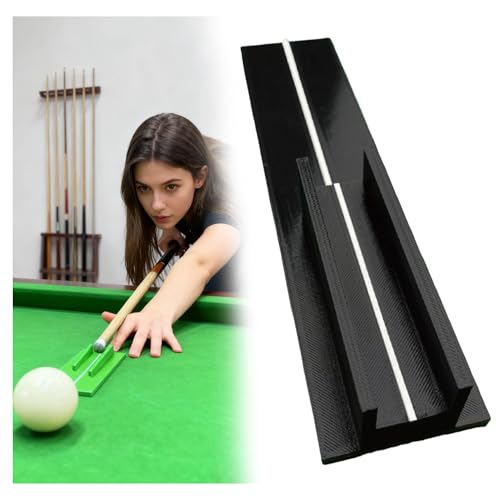
QZAVIRE 3-in-1 Billiards Stroke Trainer
Checking stance and eye line at homeThis is a small resin guide that sits on the table in front of you. The listing says it combines stance correction, eye alignment and straight-stroke practice: when two white lines on it merge into one, your head and the aiming line agree. It's cheap and its reviews are mixed, so treat it as a practice check rather than a fix. The stop-shot test above costs nothing and tells you more.
Amazon price: $13.99 as of 4:51 AM EST. Price and availability can change; Amazon’s price at purchase applies.
Check price on Amazon
Non-slip billiard shoes
Locking in your lower-body baseFlat, grippy soles keep your feet from sliding on a smooth pool hall floor, which counts most on long reaches and in a wide, low stance. Any flat non-slip shoe works; you don't need a billiards-branded one.
Check price on Amazon
Billiard glove
A bridge hand that stays put in the tripodYour bridge hand is one leg of the stance tripod. On humid nights a sticky bridge can tug the hand as the cue slides. A glove keeps the slide even so the hand doesn't move. Our pool glove guide compares specific models.
Amazon price: $30.00 as of 4:51 AM EST. Price and availability can change; Amazon’s price at purchase applies.
Check price on AmazonFrequently asked questions
What is the correct stance in pool?
The standard pool stance has the back foot on or near the shot line, the front foot forward and out at least shoulder-width, the back knee locked or nearly so, and the upper body bent so the head is low over the cue. The bridge arm is extended, and the forearm hangs vertical at the cue ball. Adjust it to your body as long as it stays stable and lines your eyes up with the shot.
How far apart should my feet be in pool?
At least shoulder-width. Wider is fine, and tall players often widen their feet to get their head lower without straining their back.
Does my back foot have to be on the shot line?
No. It's a good starting point and many players use it, but the exact spot depends on your height, hips and how open your stance is. What counts is that you're stable, your head is on the line and your arm can swing straight.
How low should I get over the cue?
As low as you can stay comfortably, because a chin close to the cue makes alignment and tip height easier to judge. If bending at the waist hurts your back or neck, bend your knees or widen your feet instead.
Should the cue be under my dominant eye?
Not necessarily. Some players align best with the cue under the dominant eye and others under the nose or between the eyes, so find your own vision center by testing straight-in stop shots and shifting your head until they go in cleanly.
Why do I miss to the same side every time?
Usually your head is off your vision center, so a straight cue looks crooked to you. If the object ball keeps missing left and the cue ball drifts right, try moving your head slightly right, and the reverse, then retest with long straight-in stop shots.
Do you have to keep a foot on the floor in pool?
Yes, under WPA rules at least one foot must be touching the floor when the tip contacts the cue ball. Shooting with both feet off the floor is a foul.
How much weight should go on the bridge hand?
Only a little. The bridge hand should be planted and steady, but most of your weight belongs on your feet. If the bridge moves when you stroke, you're either leaning on it too hard or not pressing it down at all.
Related guides
LeaguePool is reader-supported. When you buy through links on this site we may earn an affiliate commission at no extra cost to you. As an Amazon Associate we earn from qualifying purchases.