Snooker Rules for Beginners
American pool players who flip past snooker on TV usually have the same two reactions: the table is enormous, and nobody seems to be in a hurry. Both observations are correct. Snooker is a different sport that happens to share a green cloth and a cue, with its own equipment, its own scoring, and a rhythm closer to chess than to bar-room 8-ball.
The good news is that the rules are simpler than the scoring makes them look. If you understand the red-then-color sequence, you understand snooker.
The Table and Balls Are Different
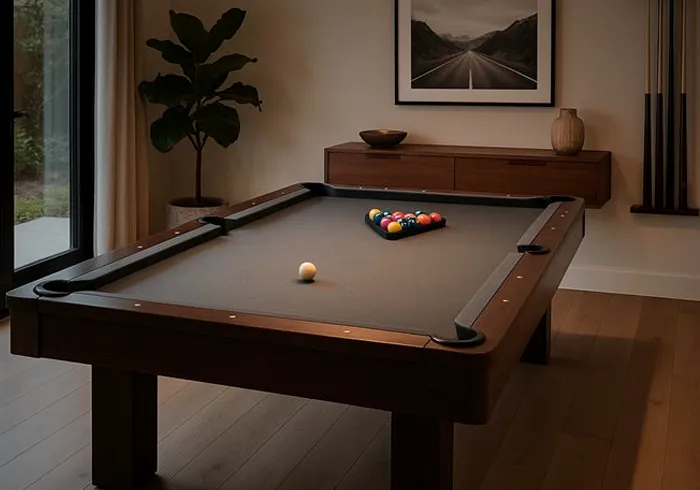
A full-size snooker table measures 12 feet by 6 feet, roughly a third longer than the 9-foot table American pool calls regulation. The pockets are narrower, with rounded jaws that reject anything hit down the rail with less than real precision. The balls are smaller too, 2 and 1/16 inches versus the 2 and 1/4 inch pool ball, and there is no numbered rack of stripes and solids.
Instead you get 15 red balls racked in a triangle, six colors that each live on a marked spot (yellow, green, brown, blue, pink, and black), and a white cue ball. The smaller balls on tighter pockets are why pool players who try snooker suddenly feel like they cannot pot anything.
The Red-Color Sequence
A turn at the table is called a break, and it follows one rule: red, color, red, color. Your first shot must be at a red. Pot it, and it stays down, worth 1 point. Now you must nominate and shoot a color, any of the six. Pot the color and you score its value, but the color comes back out onto its spot. Then it is back to a red, and so on.
Miss at any point and your opponent takes over, always starting on a red. Once all 15 reds are gone, the colors are potted in ascending order of value, and from that point they stay down. When the black finally drops, the frame ends.
Scoring and What a Frame Looks Like
The colors are worth fixed values: yellow 2, green 3, brown 4, blue 5, pink 6, black 7. Since the black is worth the most, strong players build breaks by potting red, black, red, black for 8 points a pair. The maximum break, all 15 reds each with a black plus all six colors, comes to 147, the most famous number in the sport.
A frame is one complete game, and matches are played as a race, best of 7, best of 11, and up to best of 35 at the World Championship final. Points carry no value between frames; winning a frame 60 to 59 counts the same as winning it 120 to 0.
Fouls and the Snooker Itself
Fouls in snooker give points to your opponent rather than ball-in-hand. Hitting the wrong ball first, scratching, or missing everything costs a minimum of 4 points, rising to the value of the ball involved, so a foul on the black hands over 7. That leads to the tactic the game is named for: a snooker is a shot that leaves your opponent unable to hit their legal ball in a straight line, forcing a risky escape and, often, a foul.
Late in a close frame, players stop attacking entirely and trade safeties, because a few foul points can decide the frame. This tactical layer is where snooker gets its chess reputation.
Advice for Pool Players Trying Snooker
Aim lower on the cue ball than you think you need to; the smaller, lighter ball takes spin differently, and snooker cues have smaller tips, usually 9 to 10.5 millimeters. Respect the distance. Shots that are routine on a bar table become genuine tests over 12 feet, so shorten your bridge and slow your backswing. Use the rest, the long-handled bridge tool, without embarrassment; every professional does. Finally, do not chase the 147 fantasy. Potting a red and getting position on the black, even once, is an honest first goal.
The payoff for the effort is real. A month of snooker will tighten your potting on a pool table noticeably, because pockets that once looked tiny now look generous. Many pool instructors quietly recommend snooker practice for exactly this reason, and players who grew up on the big table, from England, Scotland, and increasingly China and Thailand, tend to arrive in pool with frighteningly straight cues.
Our picks
Links open the current selection and price on Amazon so you can compare real reviews before buying.
Aramith Snooker Ball Set
Regulation 2 1/16 inch ballsA proper snooker set with 15 reds and six colors is the one purchase you cannot fake with pool equipment. Aramith phenolic sets come in full size and in smaller sizes for home tables.
Check price on AmazonTwo-Piece Ash Snooker Cue
Smaller tip, snooker balanceSnooker cues run slimmer than pool cues, with brass ferrules and tips around 9.5 millimeters that suit the smaller ball. An ash cue with a three-quarter joint is the traditional starting point.
Check price on AmazonBrass Cross-Head Cue Rest
Reaching long shotsOn a 12-foot table, no one reaches every shot, and stretching ruins your stroke. A brass cross rest on a screw-in shaft is standard equipment and works on pool tables too.
Check price on AmazonFrequently asked questions
Why do the colored balls keep coming back onto the table?
While any reds remain, every potted color is respotted on its marked spot so it can be scored again. This is how large breaks are built. Only after all 15 reds are gone do the colors stay down, potted in order from yellow to black.
What is a 147 in snooker?
It is the maximum break: 15 reds each followed by a black, then all six colors in order. That totals 147 points in a single visit. Maximums are rare enough that professionals celebrate each one, and tournaments sometimes offer bonus prizes for them.
Can I play snooker on my American pool table?
You can approximate it. Smaller snooker ball sets made for 8-foot and 9-foot tables exist, and the rules work fine. The experience differs because pool pockets are wider and the table shorter, but it is a fun way to learn the sequence and scoring.
Related guides
LeaguePool is reader-supported. When you buy through links on this site we may earn an affiliate commission at no extra cost to you. As an Amazon Associate we earn from qualifying purchases.