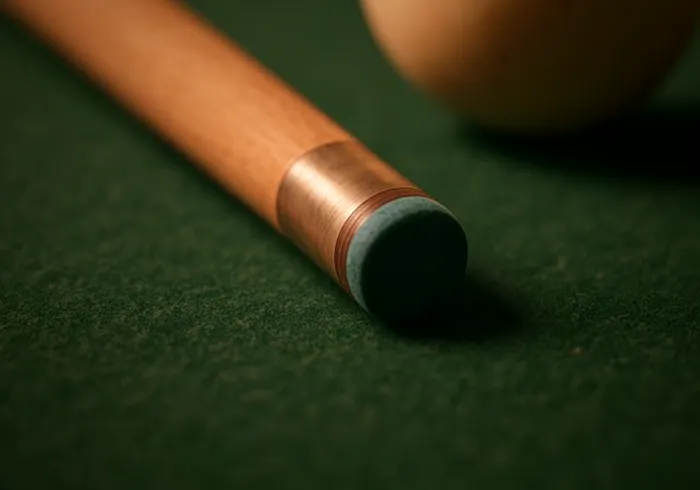
Billiards English: How to Use Side Spin in Pool
English in billiards is sidespin: you hit the cue ball left or right of its vertical centerline and it spins around a vertical axis. Its real job is at the cushion. Running english widens the cue ball's rebound angle and speeds it up off the rail; reverse english shortens the angle and slows it. Off the object ball itself, english barely changes where the cue ball goes, which surprises a lot of league players.
The catch is that english also bends your aim three ways: the cue ball squirts off line, curves back while it slides, and throws the object ball. This page covers what each one does, how much english to use, a simple way to aim with it, and when to leave it in the rack.
What english is, and why it's called that
Hit the cue ball right of center and it spins one way around a vertical axis; hit left and it spins the other. That's all english is. Combine it with follow or draw and you get spin around a tilted axis, which is why players talk about "low left" or "high right."
Players name it by what it does on a given shot... so one hit can carry two names:
| Term | What it means | Typical use |
|---|---|---|
| Inside english | Spin on the side of the cue ball toward the cut (right english on a cut to the right) | Steep cuts, holding the cue ball, rail-cut shots |
| Outside english | Spin on the side away from the cut | Removing throw on a cut, sending the cue ball wider off a rail |
| Running (natural) english | Spin that rolls the ball along the cushion as it hits | Wider rebound, more speed off the rail, multi-rail routes |
| Reverse (check, hold-up) english | Spin that fights the cushion | Shorter rebound, killing speed off the rail |
The name: the usual story is that an Englishman wowed American crowds with spin shots soon after leather tips appeared. Bob Jewett, quoted on Dr. Dave Alciatore's site, says no one knows for sure. In Britain it's just "side."
What english does to the cue ball (and what it doesn't)
English is a cushion tool. Dr. Dave's sidespin tutorrial shows it plainly: the cue ball's path off the object ball is set by the cut angle and by follow, draw or stun, while the sidespin rides along until the ball meets a rail. Then it changes the rebound!
Running english sends the cue ball off wider and livelier, which is what two- and three-rail routes depend on; reverse shortens the angle and takes speed off. The size of the change depends on spin compared with forward speed, so a slow ball bends its rebound more than a fast one. Draw helps too: the backspin wears off, the ball slows, the sidespin stays. Dr. Dave calls that a drag shot.
A useful rule of thumb from Patrick Johnson, published on Dr. Dave's site: on a ball sent straight into a side cushion, each third of maximum sidespin moves the rebound about one diamond across the table. Table speed and cloth change it, so check it on your table.
Direction off the object ball comes from follow, draw and stun; english layers on top.
How much english: tips, percentages and the miscue limit
"Give it one tip of english" means different things to different players: a full tip width off center, half a tip, or one chalk mark... A better habit, Dr. Dave suggests, is talking in percentages, with 100% at the miscue limit: about half the cue ball's radius from center, or roughly 9/16 inch on a 2-1/4 inch ball. Past that, the tip slides off no matter how well it's chalked. Our miscue guide covers that limit in detail.
| Amount | Percent of maximum | About how far the cue moves off center |
|---|---|---|
| A touch | 0 to 10% | A hair |
| Small | 10 to 30% | About 1/4 inch gives a third of max |
| Medium | 30 to 60% | About 1/2 inch gives two thirds |
| Large | 60 to 90% | Getting close to 3/4 inch |
| Near maximum | 90 to 100% | About 3/4 inch: the miscue limit |
Percentages are Dr. Dave's; the cue offsets come from Patrick Johnson's scale drawing on the same page (the round tip contacts the ball inside the cue's centerline, so 3/4 inch of cue offset lands at about 9/16 inch). To check yourself, use a striped ball: on standard sets the stripe edges mark the miscue limit. A chalk mark is about 4mm across, so maximum is three to four chalk marks out.
Squirt, swerve and throw: the three side effects
These are why english shots get missed. They point in different directions and change with different things:
| Effect | What happens (right english) | Gets bigger with | Doesn't change with |
|---|---|---|---|
| Squirt | Cue ball leaves the tip angled left of the cue's line | More english; more mass at the end of the shaft | Shot speed |
| Swerve | A raised cue makes the ball curve back to the right while it slides | More cue elevation, more english, slower speed, sticky cloth | Nothing once the ball starts rolling: it then runs straight |
| Throw | Object ball goes a little left of the contact line | Stun hits, nearly straight shots, slow cuts | Speed, when the english is small |
Squirt
The cue ball starts turning while the tip is still on it, which shoves the shaft's end sideways; that endmass pushes back and the ball squirts away from the side you hit. Robot tests show squirt doesn't vary with speed, and a low-deflection shaft reduces it by carrying less mass near the tip. Claims that squirt grows with stroke speed mix it up with swerve, below.
Swerve
Because the rails force you to raise the butt a little, nearly every english shot has some swerve. It works against squirt. On a fast shot the curve comes late, so squirt dominates and the ball ends up farther off line. On a slow shot over a long distance, the curve takes back much of the squirt. The net effect is what Dr. Dave calls squerve, and it's why the same english needs different aim at different speeds. Follow swerves sooner than draw. Swerve is a small masse; the deliberate version is in how to curve the cue ball.
Throw
Friction between the balls drags the object ball sideways, opposite your english: right english throws it left. Typical maximum throw is about an inch per foot of object ball travel, roughly 5 degrees, per Dr. Dave. Spin-induced throw is biggest on a slow, straight stun shot with about half of maximum sidespin, and adding more sidespin past that point reduces it. Follow and draw both cut throw down.
How to aim with english: back-hand and front-hand english
Most top players aim english by feel built from years of practice. If you don't have those years, Dr. Dave's back-hand english (BHE) and front-hand english (FHE) methods give you a repeatable starting point.
- Line up the shot as if you were hitting center ball, with your normal bridge.
- For BHE, keep the bridge hand still and swing your back hand sideways until the tip sits on the english you want. Back hand to the left puts on right english and angles the cue a little right, which cancels the squirt to the left.
- For FHE, keep the back hand still and slide the bridge hand sideways to place the tip. This angles the cue the other way and suits slow, long shots where swerve wins.
- Stroke straight along the new line. Don't steer back toward the original line.
Pure BHE works best on fast or short shots. Dr. Dave's handuot suggests pure BHE for those, pure FHE for slow shots with a level cue, and a blend, roughly 60% BHE to 40% FHE, at medium speed. Follow and extra elevation both swerve sooner, so they need less BHE.
BHE cancels squirt exactly only when your bridge sits at the shaft's natural pivot length. Colin Colenso's estimates on Dr. Dave's site put a regular shaft at about 9 to 9.5 inches and low-deflection shafts at 12 to 14 inches! If your bridge is much shorter than your shaft's pivot length, pure BHE over-corrects. Throw is separate: BHE and FHE handle squirt and swerve, so adjust your center-ball aim for throw first on slow or nearly straight shots.
The common BHE failure, per Colenso, is a bridge that shifts during the pivot. Practice it with a still, relaxed bridge before you trust it in a match.
Inside or outside english on a cut shot
Position usually picks the side for you. When it doesn't, the two behave differently:
- Outside english can cancel throw completely. The exact amount that does it is "gearing" outside english, in Dr. Dave's term; the balls roll against each other like gears and the object ball goes straight down the contact line. The amount needed grows with the cut angle. Too much outside, and throw comes back the other way.
- Inside english gives more predictable throw. On Dr. Dave's plots, throw changes less with small errors in inside english than in outside english, and fast inside english shots show the least throw of all.
Soft cut where the hit counts most: gearing outside. Firm cut that needs to hold or go two rails: inside is easier to repeat than people expect.
When to use english, and when to leave it alone
Dr. Dave's advice on when to learn sidespin is blunt: get your stroke solid and master stun, follow and draw before spending much time on sidespin. Then use english when the shot needs it or it clearly helps, and not when you're likely to miss because you haven't practiced aiming it.
Reach for english when:
- A natural angle off a cushion sends the cue ball to the wrong area and speed alone won't fix it.
- You need a two- or three-rail route around traffic.
- A kick needs a nudge longer or shorter (our kick shot guide covers how running and reverse english change kicks).
Skip it on a long... thin cut where position is easy, and on shots where a small aim error loses the game. Every bit of english you add brings its side effects along.
How to apply english cleanly
- Chalk before every english shot and check that the whole contact area of the tip is covered.
- Pick the amount (a third, two thirds, maximum) before you get down, then place the tip there on purpose. Don't creep outward during your warm-up strokes.
- Keep the butt as low as the rail allows. The closer to level the cue is, the less a shot with english swerves, Dr. Dave notes.
- Stroke straight through. Swiping across the ball changes both spin and direction.
- Stay inside about two thirds of maximum for normal play. Near the limit you gain very little spin for a lot more miscue risk.
If you still miscue on english shots with a chalked, domed tip, your stroke is probably steering the tip outward. Building a straight stroke fixes that faster than any equipment.
Three drills to calibrate your english
- The diamond ladder. Put the cue ball near one long rail and shoot it straight across to the far long rail, center ball, just hard enough to come back. Then add a third of maximum english, two thirds, and maximum. Mark where each rebound lands.
- The squirt check. Set a straight-in shot about two diamonds from a corner pocket. Shoot it firmly with center ball, then with medium right and left english while aiming at the same spot. Watch which way the cue ball misses its mark, then use BHE to bring it back.
- Throw on a stun shot. Take a slow, nearly straight shot along a rail with half english. Aim at the center of the pocket and watch the object ball drift toward one side. Repeat with follow; the drift shrinks.
A marked training cue ball makes all three easier to read. More in pool practice drills.
Does equipment change your english?
Not the spin. For the same contact point and speed, every cue and tip puts on the same english.. What gear changes is squirt: a low-deflection shaft or carbon shaft squirts less, so your aim correction is smaller. Tip condition and chalk decide whether you hit the spot without sliding. Details are in best cues, shafts and tips for spin and best cue tips for draw and English.
Sources
- Dr. Dave Alciatore: sidespin tutorial and sidespin terminology and uses
- Dr. Dave: tips of english and percentage spin and maximum spin
- Dr. Dave: squirt, swerve and throw effects
- Dr. Dave: what causes squirt and squirt speed effects
- Dr. Dave: back-hand and front-hand english and aiming with sidespin handout
- Dr. Dave: gearing outside english and inside spin effects
- Dr. Dave: maximum throw
- Dr. Dave: when to learn and use sidespin
Our picks
Links open the current selection and price on Amazon so you can compare real reviews before buying.

Aramith Jim Rempe Training Cue Ball
Learning exact amounts of englishA regulation 2-1/4 inch phenolic ball with Jim Rempe's rings and targets printed on it, a beginner side, an advanced side and a 56-page manual. It shows you whether that "third of maximum" was really a third, which is the whole game with english.
Check price on Amazon
Taom Pyro Chalk
Clean contact on spin shotsHandmade in Finland and sold on a clean, low-residue hit. No chalk moves the miscue limit, but one that stays on the tip and leaves little on the cue ball means fewer skids on the next shot. Chalk every english shot regardless.
Check price on Amazon
CUEDESG Low-Deflection Carbon Fiber Shaft
Less squirt for less moneyFoam-filled carbon with a pro taper, offered in 10.5, 11.8 and 12.5mm and several joints including 3/8x10 and 5/16x18. Less squirt means a smaller aim correction on english shots, but expect a few weeks of relearning your aim, and check the joint list against your cue before you order.
Check price on AmazonFrequently asked questions
What is english in billiards?
English is sidespin on the cue ball, put on by striking it left or right of center. It mostly changes how the cue ball rebounds off cushions: running english widens the angle and reverse english shortens it.
Does english change where the cue ball goes off the object ball?
Very little. The direction off the object ball comes from the cut angle and from follow, draw or stun. English makes its big change when the cue ball reaches a cushion, plus small effects from squirt and throw.
Which way does right english throw the object ball?
Left, opposite the spin. Throw is largest on slow, nearly straight stun shots and shrinks with follow, draw or more speed. Typical maximum throw is about an inch per foot of object ball travel.
Why do I miss shots when I use english?
Squirt pushes the cue ball away from the side you hit, swerve bends it back if the cue is raised, and throw moves the object ball. Aim with back-hand or front-hand english, use the same amount of spin you practiced, and keep the cue as level as the rail allows.
How much english can I put on the cue ball?
Up to the miscue limit, about half the ball's radius from center, roughly 9/16 inch on a standard ball. In practice most position play uses a third to two thirds of that, which is far safer and nearly as effective.
Why is sidespin called english?
The common story is that an English player gave spin-shot exhibitions in the US soon after leather tips appeared, and the name stuck. Bob Jewett points out nobody knows for sure. In Britain it's called side.
Does a low-deflection shaft give more english?
No. For the same contact point it gives the same spin. It squirts less, so you aim off less, and the correction stays more consistent. You'll need time to relearn your aim after switching.
Related guides
LeaguePool is reader-supported. When you buy through links on this site we may earn an affiliate commission at no extra cost to you. As an Amazon Associate we earn from qualifying purchases.