Stop, Stun, and Kill Shots Explained
Watch a strong player run a rack and you will notice something boring: the cue ball rarely does anything dramatic. It stops dead, or drifts a foot, or holds its line off the object ball. The shot underneath all of that quiet control is the stop shot, and its cousins the stun and the kill shot. If you can freeze the cue ball on command at any distance, you understand your tip, your speed, and the cloth. Everything else in position play is built on top of that one skill.
The Physics: A Sliding Cue Ball
When two balls collide dead full, the moving ball transfers essentially all of its forward motion to the one it hits. Whatever spin the cue ball carries at the moment of contact is what remains. If it arrives with topspin, it rolls forward after the hit. If it arrives with backspin, it draws back. If it arrives sliding, with zero net spin, it stops dead. So a stop shot is not about hitting hard or soft in itself; it is about engineering the cue ball to be in that slide phase exactly when it reaches the object ball. Every stop shot is really a timing problem between your tip position, your speed, and the distance to the ball.
Distance Dictates How Low and How Hard
Cloth friction is constantly converting backspin into forward roll as the cue ball travels. That gives you a sliding scale. For a stop shot at one foot, a center-ball hit at modest speed arrives still sliding. At three or four feet, you need a tip below center, or more pace, or both, because the backspin you applied decays on the way. At eight feet you need a genuinely low hit with a crisp stroke just to arrive at slide. A useful drill: set an object ball one diamond away and stop the cue ball dead, then move back one diamond at a time, discovering the tip height and speed combination each distance requires. That map, low and firm versus center and soft, is the core vocabulary of position play.
Stun Runs: Stop Shots at an Angle
Hit the same sliding cue ball into a ball at a slight cut angle and it no longer stops; it slides sideways along the tangent line, the line perpendicular to the line the object ball travels. This is a stun shot, and it is wonderfully predictable: no roll forward, no draw back, just a clean drift along the tangent at a speed you control. Players call a series of these stun runs, bumping the cue ball a foot or two sideways from ball to ball. When you hear commentators praise someone for playing simple shape, they usually mean the player kept finding small stun angles instead of forcing the cue ball around the table.
The Kill Shot: Taking Speed Off the Ball
A kill shot uses backspin at an angle to deaden the cue ball. On a cut shot, a rolling cue ball wants to bend forward off the tangent line and travel; a cue ball hit with draw fights that, arriving with backspin that eats its own energy after contact so the ball creeps only a few inches. Kill shots matter when the natural angle would send the cue ball toward a scratch or too far past position. The execution feel is a firm low hit with a short follow-through, letting the spin, not a soft stroke, do the slowing. It is the difference between babying a shot and controlling one.
Why This Is the Most Important Shot in Pool
The stop shot is the most reliable position tool in the game because it removes variables. A stopped cue ball cannot scratch, cannot drift into a cluster, and cannot leave you on the wrong side of the next ball. Whole rack patterns in eight-ball and nine-ball can be built from stop and stun shots alone, and beginners who master stop-shot speed control routinely beat flashier players who spin the ball everywhere. Ten minutes of stop shots at increasing distance, every session, will do more for your win rate than an hour of trick draw practice.
A simple benchmark: from three feet, stop the cue ball within one ball width of dead, eight times out of ten. When you can do that at five feet, you have a stroke most league opponents cannot match. Test it under a little pressure by making the last two attempts count double in your scoring.
Our picks
Links open the current selection and price on Amazon so you can compare real reviews before buying.
Striped Training Cue Ball
Seeing slide versus rollA cue ball with a visible stripe or markings shows instantly whether the ball was sliding or rolling at contact, giving you honest feedback on every stop shot attempt.
Check price on AmazonPractice Drill Cards
Structured stop-shot drillsA deck of drill cards gives you progressive stop, stun, and draw setups so practice sessions have targets and scores instead of aimless ball rolling.
Check price on Amazon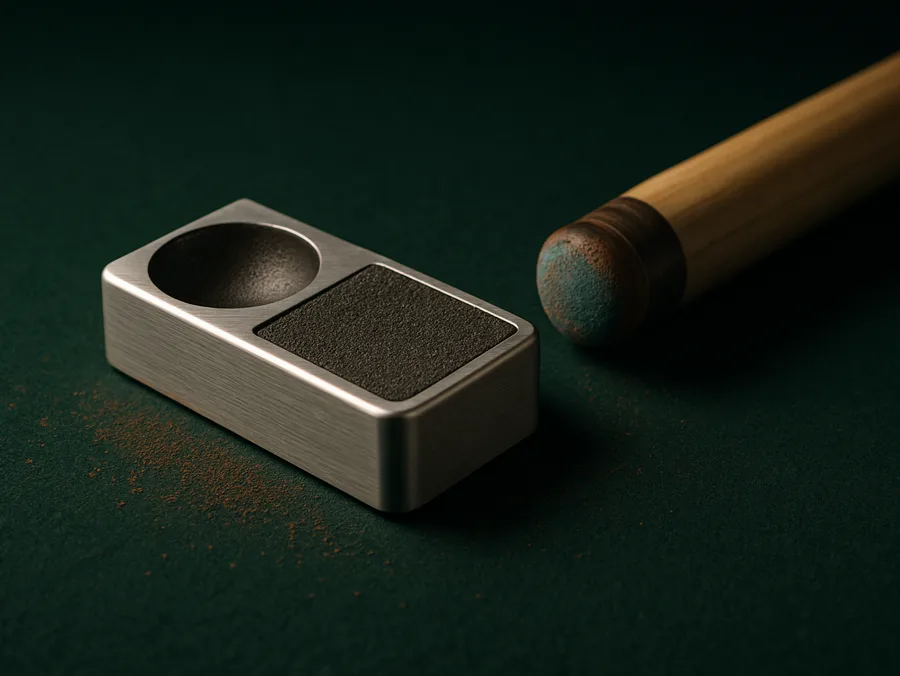
Cue Tip Shaper
Consistent low hitsStop and kill shots demand clean below-center contact, and a properly domed, scuffed tip holds chalk so those low hits do not turn into miscues.
Check price on AmazonFrequently asked questions
Why does my stop shot keep drifting forward?
The cue ball is picking up forward roll before contact, either because you hit too close to center or too softly for the distance. Move your tip lower or add speed so the ball is still sliding when it arrives.
Does a stop shot work on a cut shot?
Not as a full stop. Any cut angle sends a sliding cue ball along the tangent line instead, which is called a stun shot. The cue ball only stops dead on a full, straight hit.
What is the difference between a kill shot and a drag shot?
A kill shot uses backspin at an angle to deaden the cue ball after contact. A drag shot uses backspin on a slow shot mainly to keep the cue ball tracking straight over long distance, letting the spin wear off before contact.
Related guides
LeaguePool is reader-supported. When you buy through links on this site we may earn an affiliate commission at no extra cost to you. As an Amazon Associate we earn from qualifying purchases.