
Best Cue Ball: Replacement Cue Balls That Match
The best replacement cue ball is the one that matches your object balls: same 2 1/4 inch diameter, same 5 1/2 to 6 ounce weight, same maker and resin if you can manage it. On a home table, an Aramith cue ball from the same line as your set is the safe pick. On a coin-op table, the right answer is whatever your separator was built for, magnetic or oversized, and the wrong one simply disappears into the table.
The cue ball wears faster than any other ball because it takes every hit. Here's how to match one, what a mismatched ball does to your shots, the main Aramith cue balls and how they differ, and when cleaning will save you the purchase.
Which cue ball to buy
| Your table | Buy | Why |
|---|---|---|
| Home table with a good phenolic set | A cue ball from the same maker and line | Same resin, size and weight as the object balls |
| Home table with a cheap or unknown set | A plain 2 1/4 inch phenolic cue ball, then weigh it against an object ball | Gets you close; a new set may be the better fix |
| Home table, you want feedback | Aramith Pro-Cup measle ball | Regulation ball with six dots that show spin |
| Coin-op with a magnetic separator | Magnetic cue ball, 2 1/4 inch | The magnet pulls it off the return track |
| Coin-op that sorts by size | Oversized cue ball, about 2 3/8 inch | The gauge lets regular balls pass and catches the bigger one |
| Coin-op with an optical sensor (Diamond Smart Table) | A normal cue ball | The sensor reads the white ball, no special ball needed |
| Home table with a ball return | Any matched 2 1/4 inch cue ball | Home returns don't sort; the cue ball rolls to the tray with the rest |
Not sure what your coin-op uses? Our coin operated pool tables guide explains each separator and what happens with the wrong ball, and pool table ball returns covers home tables with a return.
Matching a cue ball to your set
Three things need to match: diameter, weight and material. The WPA's equipment spec puts all sixteen balls at 2 1/4 inches within .005 inch and 5 1/2 to 6 ounces, in cast phenolic resin. Aramith holds its own production tighter, to plus or minus 0.003 inch on diameter. The full numbers, and how to measure your balls with calipers and a kitchen scale, are on our regulation pool ball size and weight page.
Material is the one people forget. Aramith's resins run from 1.69 to 1.87 in density depending on the grade, which is why a cue ball from a different line can weigh slightly differently even at the same size. Buying the replacement from the same maker and line is the shortcut: Aramith sells its plain cue ball individually from 1 7/8 inch up to 61.5 mm, so you can match odd sizes too.
If you don't know where your set came from, weigh an object ball and the candidate cue ball in grams. A few grams apart is fine. Ten grams apart is noticeable.
What a mismatched cue ball does
Dr. Dave Alciatore, the physics professor who runs Dr. Dave Pool Info, sums up the effects of cue ball weight this way:
| Cue ball is | Stop shot | Draw and follow | Cut shots |
|---|---|---|---|
| Heavier than the object balls | Drifts forward after contact | Easier to follow, harder to draw | Cue ball goes forward of the tangent line |
| Lighter than the object balls | Bounces back after contact | Easier to draw, harder to follow | Cue ball pulls back from the tangent line |
| Larger or smaller | Contact is above or below the object ball's equator | Balls can hop, especially at speed | Rail cut shots get overcut (smaller) or hit fuller (larger) |
There's a twist with older sets. The cue ball wears fastest, so in an old set it's usually a little smaller and lighter than the object balls. Drop a brand-new cue ball into that set and it will be slightly heavier than everything it hits. If your stop shots started creeping forward right after a replacement, that's likely why, and the fix is a new set rather than a different cue ball.
Why bar cue balls feel heavy
Older coin-op tables told the cue ball apart by size or weight. One of the heaviest was the red dot cue ball on older Dynamo bar boxes, which a forum post quoted on Dr. Dave's site puts at 6.75 ounces, enough to trip a trap door in the return. Valley-Dynamo's parts manager, quoted on the same page, says Dynamo began phasing that ball out in 1993 and that all Dynamo coin tables used magnetic separation by 1995.
Oversized cue balls are still sold for size-sorting tables. Aramith's Premier oversized ball is listed at 2 3/8 inches (60.3 mm) and about 6.8 ounces, so it's both bigger and heavier than a regulation ball; per the table above, expect harder draw and a stop shot that drifts. A magnetic cue ball is regulation size, which is why players who move from oversized-ball tables to magnetic ones notice the difference right away.
Aramith cue balls compared
| Cue ball | Sizes | Markings | Use it for |
|---|---|---|---|
| Aramith cue ball (plain) | 47.6 mm (1 7/8 in) to 61.5 mm | None | Matching odd-size and small-table sets |
| Aramith Premier | 2 1/4 in | Varies by version | Replacing the cue ball in a Premier set; not magnetic |
| Super Aramith Pro | 2 1/4 in | Varies by version | Matching a Super Aramith Pro set |
| Super Aramith Pro-Cup | 2 1/4 in and 2 in | Six red dots | Tournament play and seeing spin |
| Red Circle | 2 1/4 in | Red circle | A standalone cue ball; the circle helps check the chalk mark |
| Blue Logo | 2 1/4 in | Blue logo | A regulation cue ball with a logo to watch for spin |
| Magnetic and Tournament Magnetic | 2 1/4 in | Varies | Coin-op tables with a magnetic separator |
| Premier Oversized | 2 3/8 in (60.3 mm) | Varies | Coin-op tables that sort by size; non-magnetic |
Is the Red Circle lighter than a set ball? Forum reports quoted by Dr. Dave disagree, and one says the current Aramith cue balls all share the same resin. We couldn't settle it from a published spec, so if it matters for your set, weigh one. For full sets, see Aramith pool balls compared and best pool balls.
Should the replacement be a measle ball?
If you're buying a cue ball anyway, the six-dot Pro-Cup ball is worth a look. It's the regulation tournament ball, and the dots let you see whether a draw shot is spinning or sliding and whether English crept in. You get that feedback every game without doing drills. The one catch is matching: it's made of Aramith's Pro-Cup phenolic resin, the ball that comes in Super Aramith Pro-Cup sets, so weigh it against your object balls if your set is a different line.
Marked balls built for drills, like the Jim Rempe trainer, are a separate purchase; best training cue balls compares them.
Clean it or replace it?
A cue ball that skids, feels slow or leaves marks on the cloth is usually just dirty. Chalk and hand oil build a film, and a proper ball cleaner takes it off in a couple of minutes; the method is in how to clean pool balls. Try that before buying anything.
Replace it when:
- It's chipped or cracked. A chipped ball won't roll true and can scuff the cloth.
- It wobbles or veers when you roll it slowly along the rail next to a ball that runs straight.
- It's measurably smaller or lighter than the object balls.
- It's the wrong type for your table's return.
Yellowing on its own isn't a reason. If the ball is clean and glossy and still yellow, the color is in the resin, and it plays the same. Aramith rates its phenolic balls for over 4,000,000 impacts, so a good cue ball on a home table lasts a long time; heavy use in a room or bar wears one far sooner.
Buying tips
- Buy two if the cue ball gets carried around: one in the cue case, one on the table.
- If several object balls are chipped and the set is cheap polyester, put the money toward a phenolic set instead. A premium cue ball won't make a worn set rack or roll better.
- On coin-ops, check the size, magnetic or not, before you order. Aramith's Premier is listed as not magnetic, and its oversized ball is listed as non-magnetic too.
- Keep a cue ball case or a soft bag for the spare. Dropping a ball on a hard floor is one of the easier ways to chip it.
Sources
- WPA Recommended Equipment Specifications, section 16 (balls)
- Aramith cue balls (sizes and models)
- Aramith general specifications (tolerances, density, impact resistance)
- Dr. Dave Pool Info: ball weight, size and wear effects
- Dr. Dave Pool Info: cue ball types (Dynamo history, measle knockoffs)
Our picks
Links open the current selection and price on Amazon so you can compare real reviews before buying.

Aramith Premier 2 1/4-Inch Cue Ball
Replacing the cue ball in a home setMade in Belgium from Aramith Premier phenolic resin and checked on eight criteria, including density, diameter, roundness and weight. It's not magnetic, so it's a home-table ball. The easy win: if your set is Aramith Premier, this is the exact match.
Check price on Amazon
Aramith Pro Cup Measle Cue Ball
A replacement that shows spinThe six-dot tournament cue ball. The spots make spin and movement visible, so every game doubles as stroke feedback. Choose the 2 1/4-inch size for American pool.
Check price on Amazon
Aramith Blue Logo Regulation Cue Ball
A regulation Aramith cue ballA genuine Aramith cue ball at the regulation 2 1/4-inch size and weight, with a blue logo you can watch to see how the ball turns.
Check price on Amazon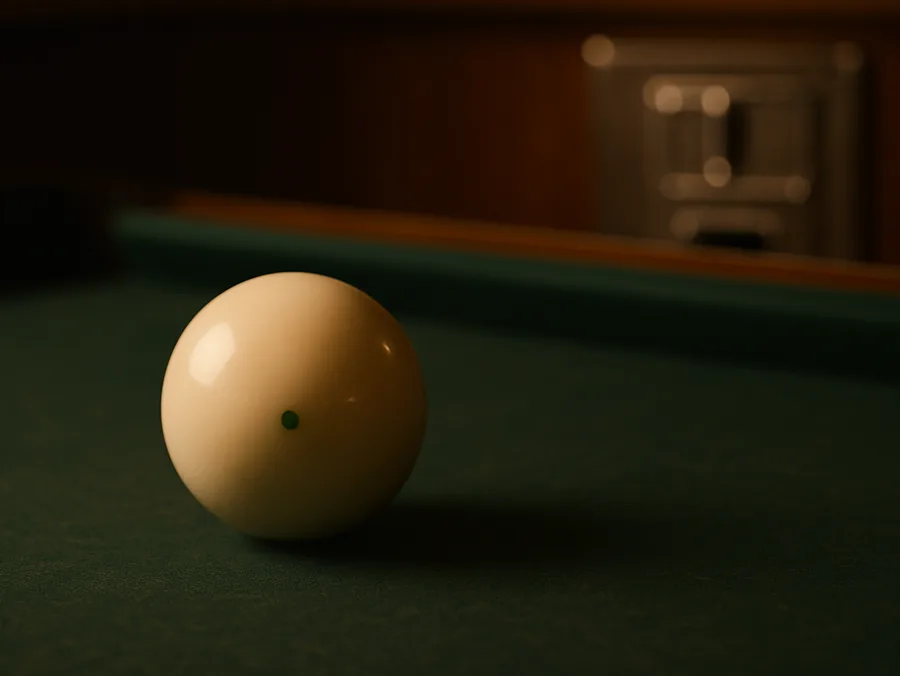
Aramith Magnetic Cue Ball, 2-1/4 Inch
Coin-op tables with a magnetic separatorA phenolic Aramith cue ball for coin-operated tables that pull the cue ball off the return with a magnet. Regulation size, so it plays far closer to normal than an oversized ball. Won't return on a size-sorting table.
Check price on Amazon
Aramith Premier Oversized Cue Ball
Coin-op tables that sort by sizeListed at 2 3/8 inches (60.3 mm) and about 6.8 ounces, in Premier phenolic, and non-magnetic. Measure the cue ball your table came with before ordering, because the gauge only works with the size it was built for.
Check price on Amazon
Aramith Billiard Ball Cleaner
Trying a clean before you replaceAramith's cleaner for phenolic balls, used with a towel or in a ball cleaning machine. Most cue balls that feel slow or skiddy are just filmed with chalk and oil, so this is worth trying first.
Check price on AmazonFrequently asked questions
What is the best cue ball?
The one that matches your object balls in size, weight and material. For an Aramith set that means an Aramith cue ball from the same line. If you want feedback too, the Aramith Pro-Cup measle ball is a regulation tournament ball with dots that show spin.
What size is a standard cue ball?
2 1/4 inches (57.15 mm) and 5 1/2 to 6 ounces under the WPA specification, the same as the object balls. Bar tables that sort by size use an oversized cue ball of about 2 3/8 inches.
Can I use any cue ball on my table?
On a home table with drop pockets, any regulation cue ball works, though a matched one plays best. On a coin-op you need the type its separator expects, magnetic or oversized, or the ball stays inside after a scratch.
Why does my new cue ball play differently?
Old object balls wear and lose a little weight and size. A new cue ball in an old set is slightly heavier than the balls it hits, so stop shots drift forward and draw is harder. Weigh both to check.
Is a heavier cue ball better?
No. A cue ball heavier than the object balls follows more easily but draws poorly and won't stop dead on a full hit. Matching weight is what makes stop shots and position predictable.
How do I know if my cue ball is magnetic?
Hold a magnet to it. A magnetic cue ball has a ferrous core and will attract a magnet; a regular phenolic ball won't.
How long does a cue ball last?
No maker publishes a lifespan in years. Aramith rates its phenolic balls for over 4,000,000 impacts. Replace one when it is chipped, out of round, noticeably lighter than the set, or the wrong type for your table.
Related guides
LeaguePool is reader-supported. When you buy through links on this site we may earn an affiliate commission at no extra cost to you. As an Amazon Associate we earn from qualifying purchases.