
Pool vs Billiards vs Snooker: What's the Difference?
Pool, billiards, and snooker all involve a cue, a cloth-covered table, and balls, so people use the words interchangeably. They are actually three distinct families of cue sports with different tables, balls, and goals. Understanding the differences helps you pick the right equipment and know what game you are really walking up to.
A note on the word billiards
Part of the confusion is that billiards means different things in different places. In much of the world, and especially in casual American usage, billiards is an umbrella term covering all cue-and-ball games including pool and snooker. More precisely, though, billiards refers to carom billiards, a family of pocketless-table games. So when someone says billiards they might mean the whole category or one specific pocketless game. Context matters.
Pool: pockets and numbered balls
Pool, also called pocket billiards, is what most people play in bars and homes. It is played on a table with six pockets, commonly seven, eight, or nine feet long, covered in a relatively fast cloth. Pool balls are larger, typically about 2.25 inches, and are numbered, with solids, stripes, and a plain cue ball. Popular games include eight-ball, nine-ball, and straight pool, all built around pocketing specific balls.
Pool cues are generally shorter and lighter, and the game emphasizes shot-making and position play over long-distance precision.
Snooker: big table, small balls, colors
Snooker is played on a much larger table, traditionally twelve feet, with six pockets that have rounded, tighter openings, on a slower, napped cloth. The balls are smaller, around 2.07 inches, and there are twenty-two of them: fifteen reds, six colors, and a cue ball. Scoring is the heart of snooker. You alternate potting a red (one point) then a color, which is re-spotted, building breaks, and the colors carry values from two to seven.
The larger table and smaller pockets make snooker a game of extreme precision, patience, and safety play. Snooker cues are longer with very slim tips to suit the small balls.
Carom billiards: no pockets at all
Carom or carambole billiards is played on a pocketless table, usually around ten feet, with just three or four balls. There is nothing to sink. Instead you score by striking your cue ball so it contacts the other balls in a required way, for example hitting both other balls in three-cushion billiards, where your cue ball must also touch at least three rails. It is a game of angles, spin, and geometry, prized for its subtlety.
Quick comparison
| Pool | Snooker | Carom | |
| Pockets | Six | Six (tighter) | None |
| Table size | 7 to 9 ft | Up to 12 ft | Around 10 ft |
| Ball size | Larger (~2.25 in) | Smaller (~2.07 in) | Large, few balls |
| Goal | Pocket your balls | Pot reds and colors for points | Carom off other balls |
If you are buying a table or cue for home, you are almost certainly in the pool category, which is the most accessible and space-friendly of the three.
Our picks
Links open the current selection and price on Amazon so you can compare real reviews before buying.
Standard Pool Cue (58 inch)
General pool play at home or the barA well-balanced maple cue sized and weighted for pool's larger balls, the right starting point for eight-ball and nine-ball.
Check price on AmazonSnooker Cue (slim tip)
The precision of the snooker gameA longer cue with a slim tip suited to snooker's smaller balls and finer aim, if you have access to a full-size snooker table.
Check price on Amazon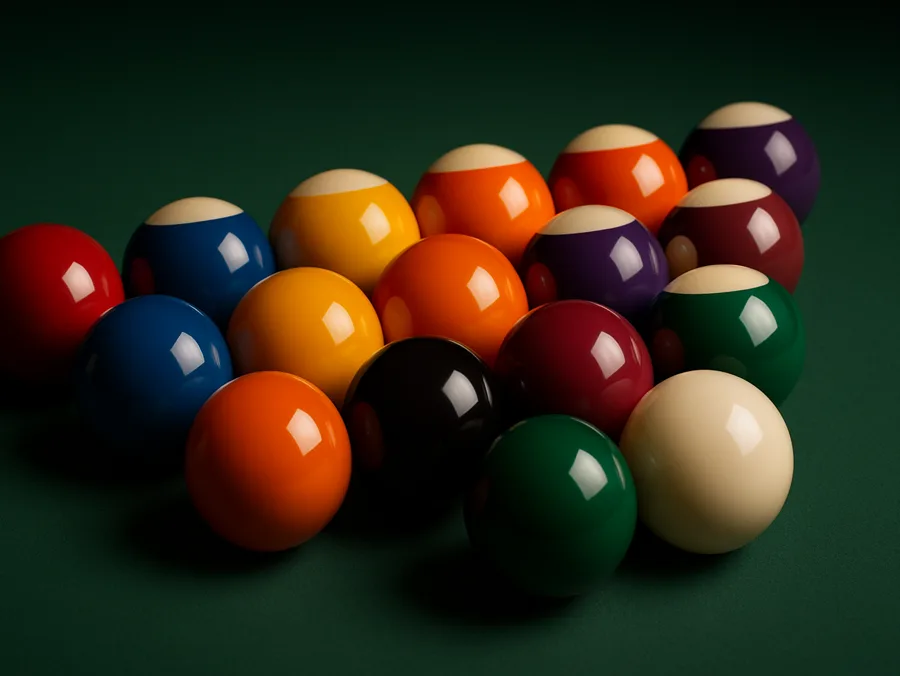
Regulation Pool Ball Set
Equipping a home pool tableA numbered set of solids, stripes, and cue ball at the standard pool size, the correct balls for the games most people actually play.
Check price on AmazonFrequently asked questions
Is billiards the same as pool?
Sometimes. Billiards is often used as an umbrella term for all cue sports including pool, but strictly it refers to carom billiards, which is played on a pocketless table. Pool specifically means the pocketed games like eight-ball and nine-ball.
Why is a snooker table so much bigger than a pool table?
Snooker evolved as a game of precision with many small balls and tight pockets, which demands a large playing surface, traditionally twelve feet. Pool tables are smaller, from seven to nine feet, to suit faster, more compact games and home spaces.
Can I play pool on a snooker table or vice versa?
Not well. The tables differ in size, pocket shape, cloth speed, and ball size, and the cues are different too. You can improvise, but each game is really designed for its own equipment, so the experience suffers if you mix them.
Related guides
LeaguePool is reader-supported. When you buy through links on this site we may earn an affiliate commission at no extra cost to you. As an Amazon Associate we earn from qualifying purchases.