Carom Billiards: The Game With No Pockets
Walk past a carom table and the first thing you notice is what is missing: pockets. Carom billiards uses a smooth, fast table and three balls, and the point is not to sink anything. You score by making your cue ball touch both other balls in one shot. Sounds easy. Then you try it, and you find one of the deepest cue sports anybody ever invented.
Carom is big in Europe, Korea, Vietnam, and Latin America, and it quietly produces some of the best cue ball control on earth. Here is how the game works and why a pool player should care.
A Table With No Pockets
A regulation carom table is ten feet long, bigger than any pool table you have played on, with an unbroken rail all the way around the playing surface. The cloth is a fine worsted weave pulled drum-tight, so balls run far faster and truer than on pool cloth. Serious rooms heat their tables with electric elements under the slate. The heat pulls the moisture out and keeps the roll the same in the last game as it was in the first.
The balls are different too. Carom uses three balls at 61.5 millimeters, noticeably bigger and heavier than the 57 millimeter balls on a pool table. Two are cue balls, one white and one yellow, so each player has their own. The third is a red object ball. Carom cues are shorter and stiffer than pool cues, with small conical tips built for precise spin instead of power.
Straight Rail and the Path to Three-Cushion
The original game is straight rail: hit both other balls with your cue ball, nothing else required. Masters got so good at nursing all three balls down a rail in tiny touches that exhibition runs climbed into the thousands of points, and the game had to be restricted to stay watchable. Balkline came next, dividing the table into zones the balls had to leave every so often.
Three-cushion was the final answer, and it is the discipline that runs the sport today. The extra requirement is brutally simple. Before your cue ball contacts the second ball, it has to touch at least three cushions. They do not have to be three different cushions, and contact with the first ball can come before, between, or after the rail contacts. The count just has to reach three.
How Three-Cushion Is Scored
Each successful carom scores one point and you keep shooting until you miss. Matches go to a set number of points, commonly 15 to 25 in amateur play and 40 or 50 among pros, sometimes with an equalizing final inning for whoever broke second.
Want a sense of the difficulty? World-class professionals average about one to two points per turn at the table. An average of 1.5 across a career puts you among the best alive, and a strong amateur is delighted to average half a point per inning. No luck to hide behind, no pocket to aim at. Only the question of whether you can bend a ball around three rails onto a spot the size of a fist.
Why Pool Players Should Try It
Three-cushion is the best school for cue ball control there is. Every shot makes you plan the cue ball's whole journey, judge how spin changes rebound angles, and hold speed across thirty feet of travel. Pool asks those questions now and then. Carom asks them on every stroke.
- You pick up the diamond systems carom players use to calculate multi-rail paths, and those carry straight into kicks and banks in pool.
- You develop real respect for running english and the way it lengthens or shortens an angle off a cushion.
- Your speed control tightens quickly, because the fast cloth punishes any laziness.
Plenty of pool champions, Efren Reyes among them, credit carom-style knowledge for their legendary kicking games.
Where to Play in the US
Carom tables are scarce in America, but they are out there. Cities with Korean, Vietnamese, or Turkish communities usually have dedicated carom rooms, and New York, Los Angeles, Houston, and northern Virginia are reliable bets. Some old pool halls keep one heated three-cushion table in the back, and the United States Billiard Association keeps lists of rooms and local leagues.
No table within driving distance? Practice the shots on a pool table. Pretend the pockets are not there, play three-cushion with pool balls, and count anything that reaches three rails. The geometry lessons come with you either way.
Our picks
Links open the current selection and price on Amazon so you can compare real reviews before buying.
Aramith Premier Carom Ball Set
Regulation 61.5mm three-ball setThe standard phenolic carom set, white and yellow cue balls plus the red object ball, sized at 61.5 millimeters for true carom play on any pocketless table.
Check price on AmazonBlue Diamond Chalk
Grippy chalk for spin-heavy playCarom players live on extreme spin. This dense Belgian chalk stays on the tip through hard follow-through strokes where bargain chalk lets you miscue.
Check price on Amazon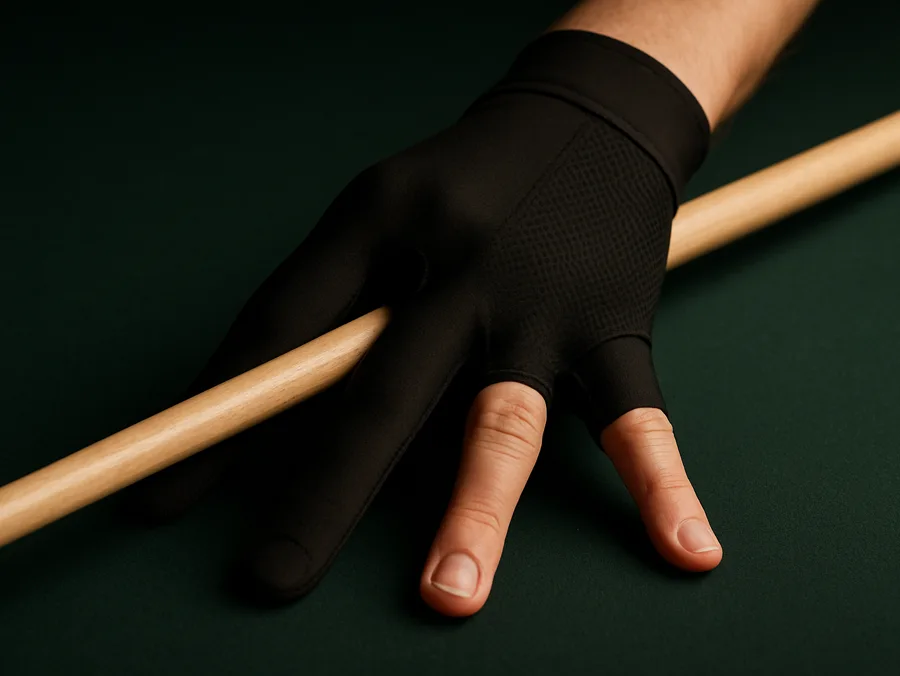
Three-Finger Billiard Glove
Fast cloth, clean glideHeated tables and worsted cloth make a smooth bridge matter even more. A glove keeps the stroke sliding through the long draws and force follows carom asks for.
Check price on AmazonFrequently asked questions
What is the difference between carom billiards and pool?
Carom uses a pocketless ten-foot table and three larger balls, and you score by caroming your cue ball off both other balls instead of pocketing anything. Pool uses a six-pocket table where you score by sinking object balls.
Why are carom tables heated?
Gentle heat under the slate drives moisture out of the cloth, which keeps the surface fast and the ball roll consistent. In a game decided by long multi-rail paths, even small changes in cloth speed would wreck the precision.
Is three-cushion billiards harder than pool?
Point for point, yes. World champions average only one to two scores per turn, while pro pool players run whole racks. The games reward different skills, but a single three-cushion point is harder than almost any pool shot.
Related guides
LeaguePool is reader-supported. When you buy through links on this site we may earn an affiliate commission at no extra cost to you. As an Amazon Associate we earn from qualifying purchases.