Pool Aiming Systems Compared
Every pool player eventually goes shopping for an aiming system, usually right after a night of missing cut shots they felt sure about. There are more systems than anyone needs: ghost ball, contact point, fractional aiming, CTE, and a dozen variations sold in books and videos. Some are genuinely useful. None of them replace hitting ten thousand balls.
Here is an honest comparison from someone who has tried most of them, with a recommendation for how to actually pick one and make it stick.
Ghost ball: the baseline everything else is measured against
Ghost ball asks you to visualize a phantom cue ball frozen against the object ball, directly opposite the pocket. Deliver your real cue ball into that spot and the object ball goes in. It is simple, it is geometrically correct for a rolling center-ball hit, and it is what most instructors teach first.
Its weakness is that the ghost is invisible and sits a full ball-width back from the object ball, farther than beginners expect. Players consistently undercut shots because they aim at the object ball surface instead of the empty space behind it. Training balls with printed targets, or simply placing a real ball in the ghost position and studying the picture, fix this faster than anything else.
Contact point and fractional aiming
Contact-point aiming skips the phantom and lines up the physical spot on the object ball with the matching spot on the cue ball. It is precise in theory but awkward in practice, because the cue ball contact point is on a curved surface you view from behind. Many players use it as a double-check on the ghost ball picture rather than a standalone method.
Fractional aiming reduces every cut to a small menu of overlaps: full ball, three-quarter, half, quarter, and thin. The half-ball hit, where the cue ball center aims at the object ball edge, sends the ball off at close to 30 degrees and becomes a reliable landmark. The appeal is speed; the catch is that real shots fall between the fractions, so you still interpolate by feel. Snooker players have won world titles on essentially this system, which says something about how far it can take you.
CTE and the pivot systems
Center-to-edge aiming, popularized by Hal Houle and Stan Shuffett, has players sight lines from the cue ball center to the object ball edge, then pivot the cue into the final aim line using fixed reference offsets. It is the most controversial system in pool. Critics point out that a small set of alignments cannot geometrically produce the infinite range of cut angles the game demands. Devotees, including some very strong players, insist it works and that the adjustments become subconscious.
The honest read: CTE gives structure and a consistent pre-shot process, and that alone improves many players. Whether the geometry or the routine deserves credit is debatable. If it intrigues you, learn it from original sources rather than secondhand forum summaries, because half-learned CTE is worse than no system.
Why no system replaces reps
Every aiming system delivers a line to the pocket. None of them deliver the cue ball down that line. That job belongs to your stance, bridge, and stroke, and a crooked stroke will miss with a perfect aim every time. Systems also ignore throw, the friction effect that pushes cut shots slightly off the geometric line, and squirt from sidespin. You compensate for both through experience, not formulas.
This is why accomplished players argue endlessly about systems yet all agree on practice. The system gets you to a reasonable starting picture quickly. The last few degrees of precision are pattern recognition burned in by thousands of made and missed balls.
How to pick one and calibrate it
Choose one system and commit for at least a month. For most players that should be ghost ball, with fractional landmarks layered on later for fast recognition.
- Set up the same medium cut shot and shoot it twenty times, noting whether misses are thick or thin.
- Adjust your ghost ball picture in the direction of the misses. That is calibration, and it is personal.
- Progress from short shots to long shots to back cuts, calibrating each range.
- Only add sidespin once your center-ball potting is reliable, because spin changes the effective aim line.
Switching systems every week resets the calibration clock to zero. Pick, commit, calibrate, and let repetition do what no system can.
Our picks
Links open the current selection and price on Amazon so you can compare real reviews before buying.
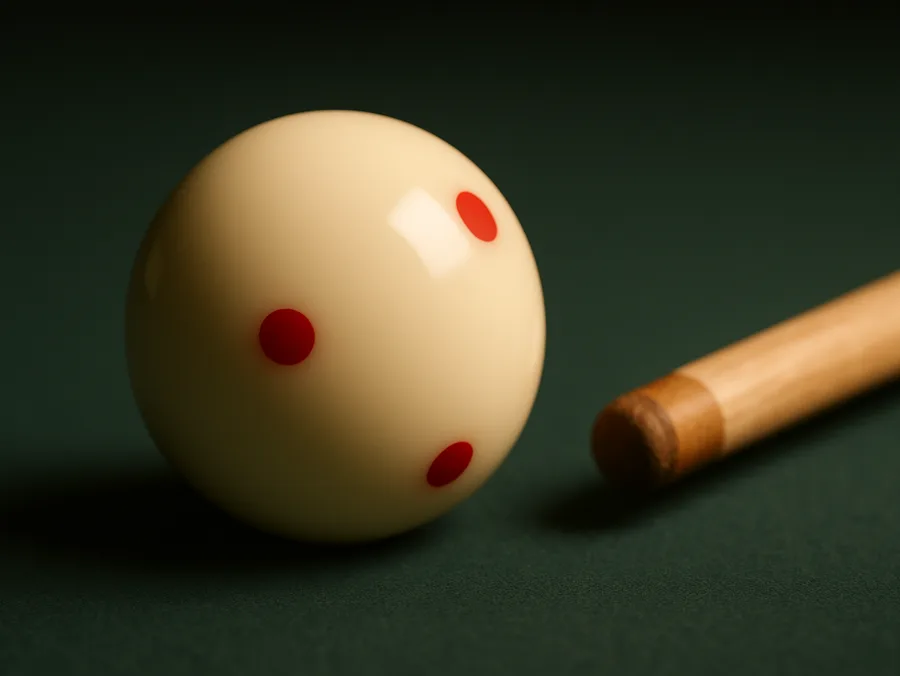
Target-marked training cue ball
Seeing contact points and tip placementA cue ball printed with rings and dots shows you exactly where your tip struck and helps build the ghost ball picture on real shots. It is the single most useful cheap training aid for aiming work.
Check price on AmazonCut angle aim trainer
Calibrating ghost ball positionA table trainer that physically marks the ghost ball position for a given cut takes the guesswork out of early calibration sessions. Use it to check your picture, then remove it and shoot the same shot cold.
Check price on AmazonPlay Your Best Pool by Phil Capelle
Aiming plus complete fundamentalsCapelle covers fractional aiming and shot-making within a full framework of stroke and position play, which is the right context for any aiming system. A better long-term buy than any single-system product.
Check price on AmazonFrequently asked questions
What aiming system do professional pool players use?
It varies, and many pros cannot fully articulate what they do because it has become subconscious. Most learned through ghost ball or fractional concepts and refined the picture with enormous practice volume. A few credit CTE or other pivot systems, but no single system dominates at the top level.
Is CTE aiming legitimate or a gimmick?
It is somewhere in between. The strict geometric claims are disputed, but the system provides a consistent visual routine that genuinely helps some players. If your current aiming is chaotic, CTE structure may help; if ghost ball already works for you, there is no compelling reason to switch.
Why do I still miss when my aim looks perfect?
Usually the stroke, not the aim. A steering stroke, an unstable bridge, or unintended sidespin sends the cue ball off the line you chose. Throw also pushes cut shots slightly thick of the geometric line. Film your stroke from behind or do stroke drills before blaming your aiming system.
Related guides
LeaguePool is reader-supported. When you buy through links on this site we may earn an affiliate commission at no extra cost to you. As an Amazon Associate we earn from qualifying purchases.