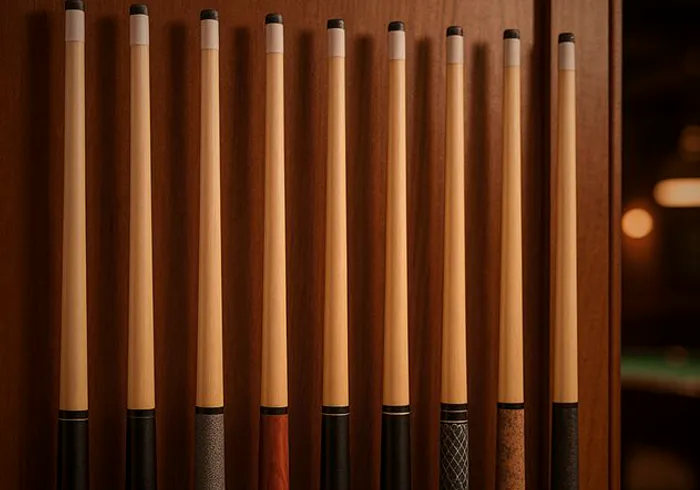
Best Break Cues
A dedicated break cue protects your playing cue and lets you hit the rack harder and more consistently. Break with your gamer and you are beating up its tip and shaft for nothing. Here is what makes a break cue work and how to pick one.
Why use a separate break cue
The break is the hardest hit in pool. Doing it with your playing cue mushrooms a soft tip, dents the ferrule, and puts stress on a low-deflection shaft that was never built to absorb it. A break cue takes that abuse so your gamer stays crisp for shooting. It also lets you set the tip and weight up purely for power, which you would never want on a shooting cue.
- Protects your gamer: No mushroomed tips or cracked ferrules on the good cue.
- Purpose-built: Hard tip and stiff shaft for maximum energy transfer.
Tip choice: phenolic vs hard leather
Tip hardness is the biggest variable in a break cue. A phenolic tip is essentially hard plastic. It grips almost nothing and moves energy very efficiently for maximum cue-ball speed, but it is less forgiving and some leagues restrict it. A very hard leather tip, or a laminated phenolic-leather tip, gives you more control and a little cue-ball feel and still hits hard. Phenolic tips are legal for breaking under most rules and banned for normal shots, because they cannot hold chalk reliably.
- Phenolic: Most power, least control, check league legality.
- Hard leather: Good balance of power and control for most players.
Weight and technique
Break speed comes from accelerating the cue through the ball with good timing, not from muscling a heavy stick around. A lot of strong breakers use a lighter cue, around 18 to 19 ounces, because they can swing it faster, and swing speed does more for cue-ball velocity than mass does. Heavier cues, 20 to 21 ounces, suit players who break with a slower, more controlled push. Experiment until you find what gives you a solid, square hit with the cue ball sitting near center table.
- Lighter (18-19 oz): Faster swing speed, favored by many pros.
- Heavier (20-21 oz): More mass for a controlled, timing-based break.
Shaft, joint, and hitting the rack square
Break shafts are stiffer than playing shafts and often a touch larger in tip diameter to survive the impact. A solid phenolic or stainless joint moves energy without flexing. All of that matters less than technique: hit the head ball as square as you can, keep the cue ball near center table so it does not fly off, and accelerate smoothly instead of lunging. A controlled break that spreads the rack beats a wild hard one that scratches.
Our picks
Links open the current selection and price on Amazon so you can compare real reviews before buying.

Break cue with phenolic tip, 19 oz stiff shaft
Maximum powerA phenolic tip puts nearly all your stroke energy into the cue ball for a fast, hard break, where the rules allow it.
Check price on Amazon
Break cue with hard laminated leather tip
Power with controlA very hard leather tip still hits big and leaves you enough feel to park the cue ball near the center of the table.
Check price on Amazon
Break and jump combo cue
One-cue valueA convertible break-jump cue covers the break and legal jump shots both, saving space and money if you are only adding one stick.
Check price on AmazonFrequently asked questions
Are phenolic break tips legal in leagues?
Most leagues allow phenolic tips for breaking, but rules vary, so check yours. They are not allowed on regular shots because they cannot hold chalk well enough to apply spin reliably.
Should a break cue be heavier than my playing cue?
Not necessarily. A lot of strong breakers prefer a lighter cue they can swing faster, since cue-ball speed depends more on swing velocity than on cue weight.
Can I just break with my regular cue?
You can, but it speeds up wear on the tip, ferrule, and shaft. A dedicated break cue is cheap insurance for a nicer playing cue.
Related guides
LeaguePool is reader-supported. When you buy through links on this site we may earn an affiliate commission at no extra cost to you. As an Amazon Associate we earn from qualifying purchases.