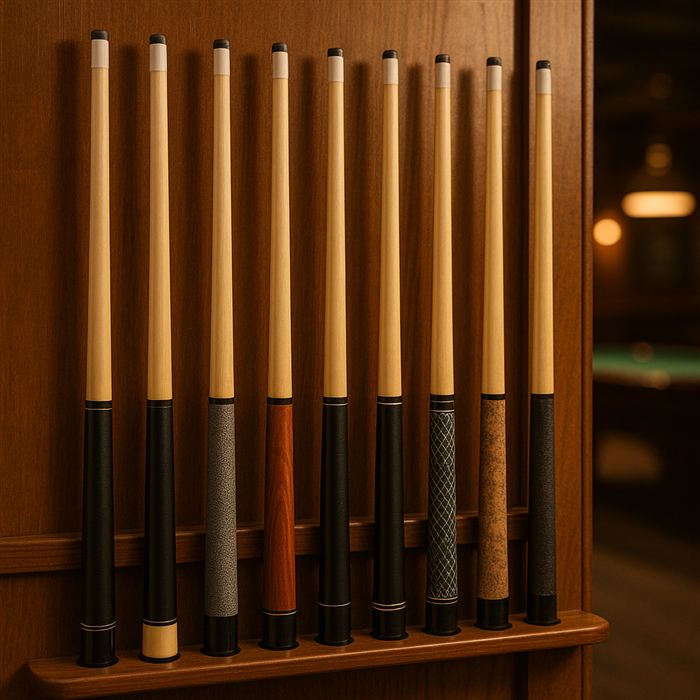
Best Jump Cues
A jump cue lets you legally lift the cue ball over a blocking ball to reach your target. Stuck behind a ball with no rail escape? A good jump cue turns that impossible safety into a makeable shot. Here is how to pick one, and how to jump without fouling.
How a jump cue works
You jump the cue ball by elevating the butt and striking downward near the top of the ball. The downward force drives the ball into the slate and it rebounds up off the bed of the table. That is the whole trick. A jump cue is short and light so you can hold it like a dart and deliver a fast, clean downward tap, and the hard tip snaps that energy in sharply so the ball hops instead of getting smothered.
- Length: Typically 40 to 42 inches, much shorter than a full cue.
- Weight: Around 6 to 11 ounces so it moves quickly with a light stroke.
Legal jumping vs scooping
Legal jumping means striking the cue ball above its center and letting it rebound off the table bed. Scooping, which is miscueing under the ball to launch it, is a foul in every standard rule set. Never dig the tip beneath the cue ball's equator. Done right, jumping is completely legal in most leagues. A few house and bar rules ban jump cues outright, so ask before you count on one.
- Legal: Hit down on the upper half; the ball bounces off the slate.
- Foul: Scooping the tip under the ball to flick it up.
Technique basics
Elevate the butt to roughly 45 degrees or more, depending on how close the blocking ball sits. Closer blockers need a steeper angle and a higher, faster jump. Use a firm dart or closed bridge, keep the grip loose, and accelerate crisply on a short stroke. Clear the obstacle by the minimum you need. Higher jumps are much harder to control on landing. Practice landing the cue ball softly too, or it will carom off somewhere useless after it clears.
- Angle: Steeper for close blockers, shallower for distant ones.
- Stroke: Short, fast, and loose, like flicking a dart.
Tip and construction
Jump cues carry hard phenolic or very hard leather tips, because a soft tip absorbs the energy and kills the jump. Many are two-piece, so the shaft doubles as part of a break cue, or they come as break-jump combos. Phenolic gives the easiest, poppiest jump. Check league legality first, since some venues restrict phenolic tips even for jumping.
Our picks
Links open the current selection and price on Amazon so you can compare real reviews before buying.
Short jump cue, 42 inch, phenolic tip
Easiest jumpsA dedicated short phenolic-tipped jump cue makes close blockers much easier to clear, thanks to the light weight and hard tip.
Check price on AmazonBreak-jump combo cue with removable sections
Value and versatilityA combo cue converts between a full-weight break cue and a short jump cue, so one purchase covers two needs.
Check price on AmazonLightweight jump cue with hard leather tip
League legalityA hard leather tip still jumps well and gets accepted in venues that restrict phenolic, which makes it the safe league choice.
Check price on AmazonFrequently asked questions
Is jumping the cue ball legal?
Yes, when you strike down on the top half and the ball rebounds off the table bed. Scooping the tip under the ball to launch it is always a foul.
How short should a jump cue be?
Most are 40 to 42 inches. The short length lets you elevate the butt sharply and use a controlled dart-style stroke to pop the ball up.
Can I jump with my normal cue?
It is possible but much harder, and it risks tearing the tip or scratching the shaft. A short, light jump cue makes the shot far easier and keeps your gamer out of harm's way.
Related guides
LeaguePool is reader-supported. When you buy through links on this site we may earn an affiliate commission at no extra cost to you. As an Amazon Associate we earn from qualifying purchases.