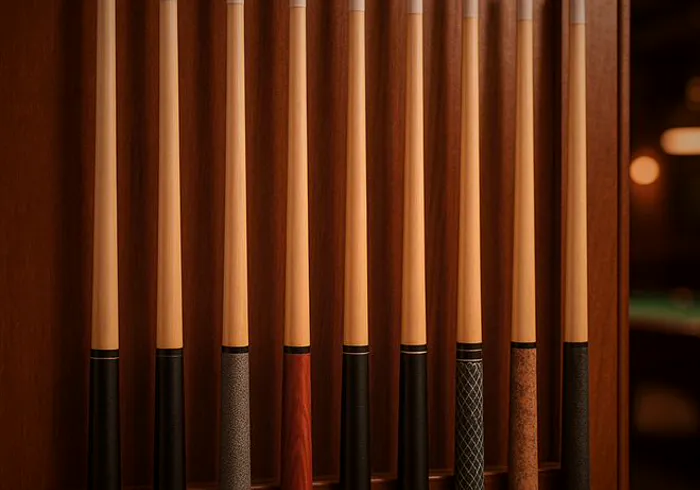
Best Meucci Pool Cues
Ask an older room player about Meucci and watch their eyes light up. Bob Meucci started building cues in Mississippi in the 1960s, and by the 1980s and 90s Meucci Originals were everywhere: on TV, in the hands of champions, on the wall of every serious pool hall in America. The legend rests on two things. Gorgeous classic designs, and the softest hit in production cues.
The company is still family-run and still building in the USA, which at these prices almost nobody else can say. Here is what makes the cues distinctive and which models still earn a spot in the case.
The Meucci Hit: Soft and Alive
Every cue brand has a personality, and Meucci's is unmistakable. The shafts get a long pro taper that leaves them more flexible than almost anything else on the market. That gives you a soft, springy hit that generates spin with little effort and sends an enormous amount of feedback back into your hand. Owners say it feels like the cue is working with you; the cue ball seems to take english for free.
It is a love-it-or-leave-it trait, honestly. Players raised on stiff modern shafts sometimes find the flex unnerving on power shots. Players who live on touch, the straight pool and one pocket crowd especially, will not play anything else.
Black Dot and The Pro Shafts
Meucci was arguing about cue ball deflection decades before low deflection became a marketing category, and testing shafts on its own robot rig while it argued. The modern results are the Black Dot Bullseye shaft and The Pro shaft, both built to cut deflection without losing the Meucci feel.
The Black Dot tests well against LD shafts that cost considerably more, and Meucci claims class-leading numbers from that robot. Take any maker's own numbers with salt. The player consensus is real anyway: these deflect far less than a standard shaft and still hit like a Meucci, which no Predator or carbon shaft manages.
Made in the USA, Still
The cues are built in Sweetwater, Tennessee, and the company stayed in the Meucci family through Bob Meucci's passing in 2024. That was a real end of an era for American cue making. Domestic production at import-adjacent prices is Meucci's quiet advantage; most competitors in the $400 to $700 range are built overseas.
The flip side, said plainly: Meucci production quality has had up-and-down stretches over the decades, and the finish work does not match the consistency you get out of a Japanese shop like Mezz. You are buying character, heritage, and that hit. Not laboratory uniformity.
The Four Picks Explained
The Meucci Hall of Fame series is the top of the range, built around the brand's championship history with premium wood, classic point work, and The Pro shaft; take it if you want the full Meucci experience. The Meucci 97 series brings back the 1997 designs that defined the golden era, veneered points and traditional wraps. The Meucci All Natural Wood series drops paint and dye for pure figured wood, and it is quietly stunning in person. Then there is the sleeper. The Meucci Sneaky Pete with Black Dot shaft looks like nothing at all, carries the brand's best LD shaft, and is the cheapest way into a real Meucci hit.
Who Should Buy a Meucci
Buy one if feel and feedback matter more to you than stiffness, if you like classic American cue looks, or if owning a piece of pool history is part of the appeal. The soft hit flatters finesse players and anyone whose game runs on spin and touch.
Skip it if you break hard with your playing cue, if you prefer the dead-stiff precision of carbon fiber, or if you want ruthless factory consistency. And if a clean older Meucci Originals model turns up secondhand, grab it. The vintage cues have a devoted collector market and hold their value.
Since hunting used Meuccis is half the fun of the brand, one note on that market: the condition of the original shaft matters more than cosmetic wear on the butt. The shaft is the heart of the hit. A vintage butt with a modern Black Dot shaft on it is a legitimate and popular combination. Watch for refinished cues being sold as original, check that the points are even, and be skeptical of any seller who will not roll the cue on camera. Clean 80s and 90s pieces have climbed steadily in price, so a fair deal today usually looks like a bargain in five years.
Our picks
Links open the current selection and price on Amazon so you can compare real reviews before buying.
Meucci Hall of Fame Series
The full flagship experiencePremium builds tied to Meucci's championship years, shipped with The Pro shaft. About as close as a production cue gets to the brand's custom-era work.
Check price on AmazonMeucci 97 Series
Classic 90s Meucci styleStraight revivals of the 1997 catalog that made the brand famous, with traditional points, veneers, and wraps and the soft signature hit.
Check price on AmazonMeucci All Natural Wood Series
Pure figured wood looksNo paint and no dye, just book-matched exotic wood under a clear finish. The quiet connoisseur's pick in the lineup.
Check price on AmazonMeucci Sneaky Pete Black Dot
Cheapest real Meucci hitPlain-Jane styling with the brand's best low-deflection shaft on it. The cheap way into the Meucci feel.
Check price on AmazonFrequently asked questions
Are Meucci cues still made in the USA?
Yes. The cues are built in Sweetwater, Tennessee, and the company has stayed in the family since Bob Meucci started it in the 1960s. Very few American production cue makers are left at mid-range prices.
Why do Meucci cues hit so soft?
The shafts use a long pro taper that leaves them noticeably more flexible than other brands. That flex softens the hit, adds feedback, and makes spin easier to get. It is a deliberate design choice, not a defect.
Is the Black Dot shaft really low deflection?
Yes. Meucci's own robot testing puts it at the top of the class, and while any maker's own numbers deserve a squint, players consistently report far less deflection than a standard shaft. It competes with LD shafts that cost more.
Related guides
LeaguePool is reader-supported. When you buy through links on this site we may earn an affiliate commission at no extra cost to you. As an Amazon Associate we earn from qualifying purchases.