
Pool Cues Made in USA: Every American Cue Maker
The best pool cues made in the USA come from seven established shops: McDermott, Viking, Pechauer, Jacoby and Schon in Wisconsin, Meucci in Mississippi and Joss in Maryland, plus dozens of small custom makers. The cheapest new American-made playing cues run about $325 to $475 (a Pechauer JP, a Viking Ovation or Kayano, a Jacoby MAG1, a McDermott G-Series, a Meucci Sneaky Pete), and Schon starts around $1,045.
Watch the budget lines. McDermott's Lucky and Star cues and Viking's Valhalla cues carry American names but are built overseas, by the makers' own descriptions. Below is who builds where, what each costs, how the warranties differ, and how a cue is actually made.
Pool cue makers that build in the USA
Each line below is what the maker itself says, read on October 15, 2026. Starting prices come from our brand guides (maker list or dealer prices that day).
| Maker | Where | Since | What the maker says | Cheapest new playing cue |
|---|---|---|---|---|
| McDermott | Menomonee Falls, Wisconsin | 1975 | McDermott cues are "proudly made in the U.S.A."; Star and Lucky are made globally | G-Series from $445 list |
| Viking | Middleton, Wisconsin | 1965 | "Every part of every Viking cue is made in the United States"; Valhalla is a premium import line | Ovation from $365, Kayano $375 |
| Pechauer | Green Bay, Wisconsin | 1963 (first cue) | Cues are 100% made in-house, with its own sawmill and vacuum kiln | JP about $324 at Seybert's |
| Jacoby | Nekoosa, Wisconsin | 1982 | "American owned and operated", builds custom and production cues | MAG1 about $375 |
| Schon | Milwaukee, Wisconsin | 1981 | Handcrafted custom cues by master craftsmen in the USA | About $1,045 (STL 01) |
| Meucci | Byhalia, Mississippi | 1975 | "Proudly Made in the USA Since 1975", built to order | $475 (Sneaky Pete) |
| Joss | Towson, Maryland | 1968 | "Handmade in the USA Since 1968" | Not listed on its home page |
Wisconsin has more American cue makers than any other state on this list: five of the seven. Several, including McDermott, Viking, Pechauer, Meucci and Schon, publish factory repair services.
Famous names that are not built in the USA
This is where buyers get caught, because the brand on the butt is American.
- McDermott Lucky and Star: McDermott says Star cues are manufactured globally, and our McDermott guide covers both lines. Only McDermott-branded lines such as the G-Series get the made-in-USA label and the lifetime warranty with warping.
- Valhalla by Viking: Viking calls Valhalla "a premium import cue line", designed by Viking. See the Valhalla guide.
- Mezz: made by Miki Co. in Japan (Mezz guide).
Then there are big brands that don't say where their cues are built. Predator is headquartered in Jacksonville, Florida, and Cuetec is distributed by Imperial International in the US, but neither states a manufacturing location on the pages we read. Cue & Case doesn't publish one for Players or Lucasi. None of them markets its cues as made in the USA, so if that label matters, ask the dealer before you pay.
Watch the wording, too. "Designed in the USA", "engineered in the USA" and "made in the USA" are three different claims. Only the last one tells you where the cue was built.
Best American-made pool cues by buyer
- Most players: a McDermott G-Series with the G-Core shaft. It's made in Menomonee Falls from $445 at list, takes weight bolts, and its lifetime warranty covers warping. The plain models (G201, G240, G241) cost the least, so the money goes into the build rather than inlays.
- Built to order on a budget: a Viking Kayano at $375 with the ViKORE low-deflection shaft, or a Pechauer JP where you pick the joint, weight and shaft. Both are among the cheapest new American cues.
- A classic flexible hit: a Meucci. Every current model lists The Pro maple shaft on a 5/16x18 pin, so the $475 Sneaky Pete plays like the $1,500 BMC Casino. The catch is a one-year warranty that excludes warpage.
- Small-shop handmade: Schon, from about $1,045, where each cue is built at one of five tables by one craftsman. Used Schons are how most players get in.
- Carbon from an American shop: Jacoby's BlaCk V5 ($495) or V4 ($375) carbon shafts, sold in many other makers' pins, or Pechauer's Rogue 2 ($510). Neither maker says where the carbon itself is produced, so ask if that detail matters to you.
- Break and jump: Jacoby's break and jump line and McDermott's Stinger, covered in break-jump cues.
Warranty differences between American makers
Made in the USA doesn't mean the same warranty. This decides more about long-term value than the country of origin does.
| Maker | Term | Warpage | Conditions worth knowing |
|---|---|---|---|
| McDermott (own lines) | Lifetime | Covered | Original owner, authorized dealer, receipt; shaft turned below 11.75mm voids it |
| Viking | Lifetime | Covered | Register within 60 days; wear parts excluded |
| Pechauer | Lifetime on defects | Not named | Heat and humidity damage excluded; claims go to Pechauer |
| Jacoby | Lifetime on defects | Excluded | Third-party alterations void it |
| Meucci | One year | Excluded | Authorized dealer, original purchaser |
| Schon | Not published | Not published | Ask in writing before you buy |
No American maker's warranty transfers to a second owner, so used cues are bought as-is.
What pool sticks are made of
| Part | Usual material |
|---|---|
| Shaft | Hard rock maple on most pool cues (ash on most snooker cues). Low-deflection shafts use spliced or cored maple; carbon shafts wrap carbon fiber around a foam or hollow core |
| Tip | Leather, single piece or layered, about 12 to 14mm on pool cues |
| Ferrule | Fiberglass, phenolic or other resins (ivory on old cues) |
| Joint | Steel or brass pin and insert, with stainless, phenolic or wood collars |
| Forearm and sleeve | Maple, or exotic woods such as cocobolo, bocote, rosewood and ebony, often with inlays |
| Wrap | Irish linen, leather, nylon on cheap cues, or none |
| Weight bolt | Metal bolts or cartridges in the butt that set total weight |
Fiberglass and graphite cues swap the wood for composites, which trades feel for dent and warp resistance; our fiberglass vs graphite guide compares them. For a labeled diagram of every part, see pool cue parts explained.
How pool cues are made
Makers keep their exact methods to themselves, but what they publish describes the same basic path:
- Select and dry the wood. McDermott starts every shaft from kiln-dried, hand-selected North American hard rock maple; Pechauer runs its own sawmill and vacuum kiln to cut and dry its wood.
- Turn it down in stages. A shaft isn't cut to size in one pass. McDermott says its shafts are turned 11 times for stability, and Players' listings say its maple is turned and dried seven times during curing. Resting the wood between cuts lets it settle before the final size.
- Build the butt. Forearms, handles and sleeves are glued up from the core wood and decorative woods, and points or inlays are cut. Cues can be spliced by hand or by machine.
- Fit the joint and ferrule. The pin, insert and collars are machined so the halves meet flush; Pechauer even makes its own patented joint screw and insert.
- Finish and wrap. Viking uses a UV-cured coating; linen or leather wraps are pressed on.
- Install the tip, then check straightness, weight and balance.
McDermott counts over 150 separate procedures in each cue. Numbers like that are why an American production cue costs more than an import with the same wood: it's labor and inspection, done in a US shop.
Small custom cue makers
Above the production shops sit one- and two-person custom makers, many of them members of the American Cuemakers Association, which formed in 1992 to promote the American-made cue. Its members exhibiting at the 2025 Super Billiards Expo included Barnhart, Cohen, Capone, Diveney, Franco, Jerry Olivier, John Bender, McWorter, Mike Stacey, Nitti, Prather, Treadway, Steve Dunkel, Shelby and Doug Beasley, alongside Pechauer, Jacoby, Joss and Viking. The ACA keeps a membership roster on its site.
Custom cues cost more and often take months. Our custom cue cost guide covers prices, deposits and wait times.
What American-made gets you, and what it doesn't
It gets you a maker you can call. McDermott has a lifetime maintenance plan for its American-made cues, Schon publishes a repair price list and a $30 identification service, and Meucci and McDermott will help identify an older cue from photos. Matching replacement shafts come from the same shop. It also tends to get you better resale: established American names keep a used market, while budget imports resell for little.
It doesn't get you accuracy. No butt aims better than another. If your misses come from side spin, a low-deflection shaft does more than any country of origin; a $150 import with a good low-deflection shaft can outplay a plain-maple American cue for a player who uses english. Our low deflection explainer covers why.
Buy American when you want one cue for a long time, a shop that will service it, and a warranty you can read. Buy an import first if you're new: a season with a good first cue tells you the weight and shaft size to order.
Buying a used American cue
Used American cues are often the best value, because the first owner takes the drop. The warranty stays with that first owner, so check the cue yourself: roll each half on a flat table, screw the joint together by hand and look for a gap, check the ferrule for hairline cracks and the finish for bubbling. Measure the shaft; one sanded well below its original size has lost material, and McDermott and Viking won't warranty shafts under 11.75mm even for original owners. Ask what has been refinished or replaced. Our used cue checklist and what old cues are worth cover pricing.
Pool tables made in the USA
Tables are a separate shopping trip. Diamond builds in Jeffersonville, Indiana, Olhausen in Portland, Tennessee, and Connelly in Richland Hills, Texas; our pool table brands guide compares them, and Olhausen has its own page.
Sources
- McDermott: company history, manufacturing and brands
- Viking: Global Vision (made in the USA, materials) and Valhalla
- Pechauer: history and in-house manufacturing
- Jacoby Custom Cues and its shafts
- Schon Cues
- Meucci Cues
- Joss Cues
- American Cuemakers Association
- Wikipedia: Cue stick (materials and construction)
Our picks
Links open the current selection and price on Amazon so you can compare real reviews before buying.

McDermott G241 Pool Cue with G-Core Shaft
Best American-made cue for most playersOne of the plain G-Series models at the bottom of McDermott's price range, made in Menomonee Falls with the G-Core shaft (maple with a carbon fiber core). Your money goes into the build, and the lifetime warranty covers warping when you buy from an authorized dealer.
Check price on Amazon
Meucci SW Bar Box 1 Low-Deflection Cue
Classic American hitMade in the USA by Meucci with a smoke-stained maple forearm, curly maple points and Meucci's Pro Series shaft. Real points and a wrap for not much more than the plain Sneaky Pete. Know the warranty: one year, warpage excluded.
Check price on Amazon
Viking Kayano Pool Cue
Built to order for lessMade in Middleton, Wisconsin, with stained curly maple, an Irish linen wrap and the ViKORE low-deflection maple shaft included. You pick weight and tip size, and the lifetime warranty covers warpage once you register it within 60 days.
Check price on Amazon
Pechauer JP Series Cue
Handmade, your specBuilt to order in Green Bay with the Speed Joint or a pin you choose, 18.5 to 21 oz, and an optional Performance Plus or Rogue 2 shaft. Buy it from an authorized dealer for the lifetime defect warranty.
Check price on Amazon
Jacoby BlaCk V5 Carbon Shaft
American carbon for your buttThe carbon shaft from Jacoby of Nekoosa, Wisconsin, in 11.0 to 12.7mm and sold in many other makers' pins, including McDermott quick release and Cuetec 3/8-14. Confirm your pin first; a wrong-pin return costs shipping plus a restocking fee.
Check price on Amazon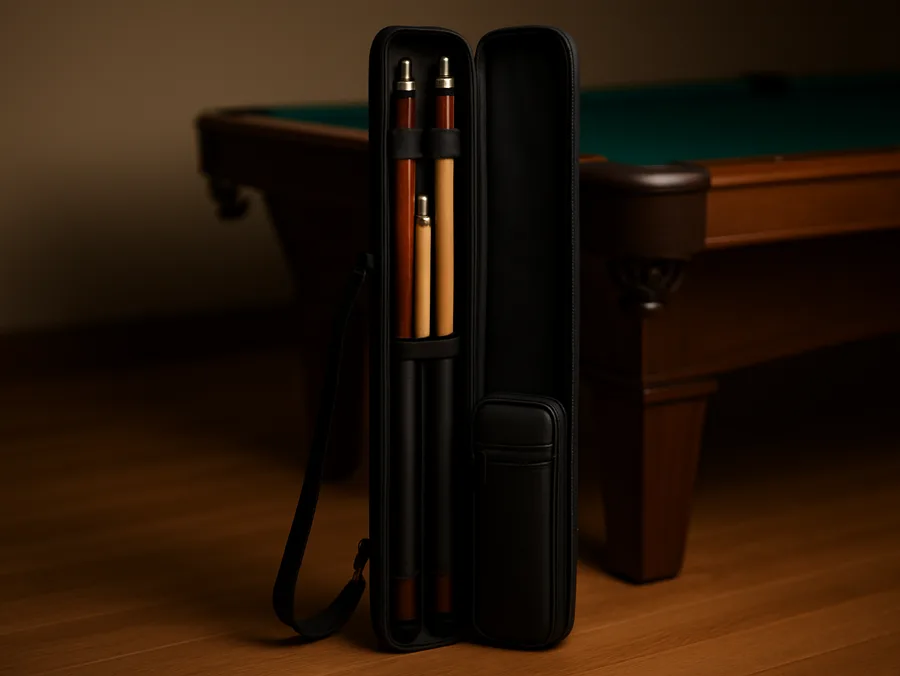
Casemaster Q-Vault Classic 2x2 Hard Case
Protecting the investmentA full-length hard resin shell with a soft lining, room for two butts and two shafts, and pockets for chalk and tips. Heat and humidity damage isn't covered by most cue warranties, so a hard case is cheap insurance.
Check price on AmazonFrequently asked questions
Which pool cue brands are made in the USA?
McDermott, Viking, Pechauer, Jacoby and Schon in Wisconsin, Meucci in Mississippi and Joss in Maryland, plus many small custom makers. McDermott Lucky and Star, Viking Valhalla and Mezz are not made in the USA.
What is the best American-made pool cue?
For most players, a McDermott G-Series with the G-Core shaft: made in Wisconsin, from $445 at list, with a lifetime warranty that covers warping. A Viking Kayano or Pechauer JP is the pick if you want a cue built to your spec.
Are McDermott cues made in the USA?
McDermott's own cues are made in Menomonee Falls, Wisconsin, and McDermott calls them proudly made in the U.S.A. Its Star cues are manufactured globally, and Lucky cues are made overseas too.
Are Valhalla cues made in the USA?
No. Viking calls Valhalla a premium import cue line. Viking's own cues are made in Middleton, Wisconsin.
How much does an American-made pool cue cost?
New production cues start around $325 to $475 (Pechauer JP, Viking Ovation or Kayano, Jacoby MAG1, McDermott G-Series, Meucci Sneaky Pete). Schon starts near $1,045, and custom cues cost more.
What are pool sticks made of?
Most pool cue shafts are hard rock maple, with a leather tip, a fiberglass or phenolic ferrule, a metal joint pin and a butt of maple or exotic woods with a linen or leather wrap. Some shafts are carbon fiber over a foam core.
How are pool cues made?
Makers dry and select maple, turn the shaft down in many stages so the wood settles (McDermott says 11 turns), build the butt from core and decorative woods, machine the joint and ferrule, finish and wrap the cue, then install the tip and check it for straightness.
Do American-made cues play better?
Not in accuracy. They buy you consistent construction, factory repairs and better resale. For measurable improvement with english, a low-deflection shaft matters more than where the butt was made.
Does Jacoby make an Edge Hybrid shaft?
Not that we could find. Jacoby's current shafts are the BlaCk V5 and BlaCk V4 carbon shafts, the Ultra maple shaft (Ultra Pro and Super Pro) and the KW shaft.
Related guides
LeaguePool is reader-supported. When you buy through links on this site we may earn an affiliate commission at no extra cost to you. As an Amazon Associate we earn from qualifying purchases.