Best Pool Cue Sets for Home Tables
A home pool table has a problem the pool hall never mentions: guests. Two friends come over, then four, and suddenly the one nice cue you own is being chalked upside down by somebody's cousin. The answer is a set of house cues. Matched sticks that live at the table, take abuse gracefully, and let everyone play without negotiating over equipment.
Sets are also just the cheap way to outfit a table. Four decent cues bought together cost less than four bought one at a time, and a matched set looks right on a wall rack.
Why sets beat singles for a home table
Guests need cues nobody has to worry about, and a matched set handles several problems at once. Everyone plays with roughly the same equipment, so nobody gets stuck with the obviously worst stick. Replacement is easy, because when one cue eventually gets stepped on, the set still matches. Per-cue cost drops a lot too, since four-cue sets often land near the price of two comparable singles. Keep your personal cue separate and off-limits. The house set exists so your good cue never has to meet the floor.
One-piece versus two-piece sets
One-piece cues are the classic house cue. Nothing to unscrew, nothing to loosen, no joint to abuse. They are the most durable option and the right default for a dedicated game room with wall storage. Two-piece sets cost a bit more but store in less space and can leave the house for a night at the hall. For most home tables the one-piece set wins on toughness. If your storage is a closet rather than a wall rack, go two-piece.
- One-piece: maximum durability, needs a wall or floor rack.
- Two-piece: compact storage and portability, one more part to loosen over time.
Quality markers that actually matter
Cheap sets fail in predictable places, so check three things. Straightness first: roll each cue on the slate and watch the tip end for wobble, then do it again a month later, because green wood moves. Tips second: house-cue tips are usually pressed leather glued on at the factory, and a good one holds chalk and keeps its dome while a bad one glazes over or pops off. Budget a few dollars for replacement tips, because you will need them. Ferrules third: look for a flush seam with no cracks, since ferrule damage is what actually kills house cues.
Finish quality breaks the tie between otherwise similar sets. A smooth, sealed shaft glides through a bridge hand. A rough or tacky one drags and makes every guest shoot worse. If a set shows up with sticky shafts, a light going-over with a shaft slicker or a very fine abrasive pad fixes it in minutes. Do that before the housewarming, not after.
Weights, lengths, and mixed households
A smart set covers different players. Sets sold in mixed weights, say 18 through 21 ounces, let guests find what suits them, and the weight is usually stamped on the butt so nobody has to guess. If kids play at your table, add one or two 48 or 52 inch shorty cues to the rack. They are cheap, and a short cue helps in tight rooms too, where a wall sits close enough to cramp a full stroke. Standard 57 to 58 inch cues handle everyone else.
Storage keeps the set alive
Fastest way to ruin a cue set is to lean it in a corner, where the cues bow under their own weight and get knocked over. A wall-mounted rack costs little, holds six to eight cues vertically, and doubles as the place chalk and the bridge head live. Floor racks work where walls do not. Keep cues away from radiators and out of garages with big humidity swings, and wipe the shafts down now and then. House cues are low-maintenance, not no-maintenance. A rack plus a set is the whole answer, and plenty of sets bundle both.
While you are outfitting, finish the table kit in the same order: a bridge stick for the shots you cannot reach, a box of chalk cubes so one is always within arm's length, and a table brush. None of it costs much. A table with a complete, matched kit gets played more, because the friction of hunting for chalk or sharing three cues among five people is what leaves home tables gathering laundry.
Our picks
Links open the current selection and price on Amazon so you can compare real reviews before buying.
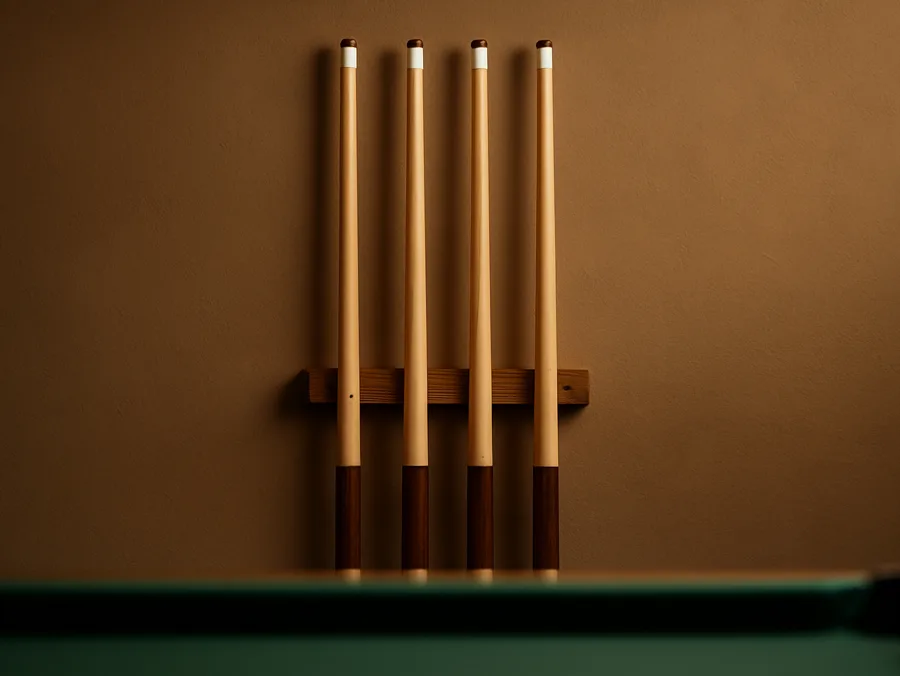
Viper One-Piece House Cue Set
Durable wall-rack setClassic one-piece house cues in a matched set. The toughest option for a table that sees guests, kids, and parties.
Check price on AmazonIszy Billiards Two-Piece Cue Set of 4
Best value four-packFour two-piece cues in mixed weights at a per-cue price that is hard to argue with. One purchase and the table is outfitted.
Check price on AmazonGSE Games and Sports 4-Pack Cue Set
Mixed weights for guestsA budget matched four-pack sold in assorted weights, so different players can each find a stick that suits them.
Check price on AmazonPlayers Value Pack Cue Set
Step-up quality setPlayers brings its cue-brand quality control down to a value pack. Pick this when you want house cues that play noticeably better than the bargain tier.
Check price on AmazonFrequently asked questions
How many cues should a home table have?
Four is the sweet spot. It covers doubles without sharing and fills a wall rack nicely. Two works for a household that rarely hosts, and six is worth it if your table is the party table.
Are cheap cue sets straight?
Usually straight enough for casual play. Check every cue when it arrives by rolling it on the table and watching the tip for wobble, then check again after a month. Send back a set with a badly warped cue. A slight roll on a house cue is normal and you will not notice it in play.
What weight should house cues be?
Buy a mixed set covering roughly 18 to 21 ounces so guests can pick by feel. If the set comes in a single weight, 19 ounces suits the most players.
Related guides
LeaguePool is reader-supported. When you buy through links on this site we may earn an affiliate commission at no extra cost to you. As an Amazon Associate we earn from qualifying purchases.